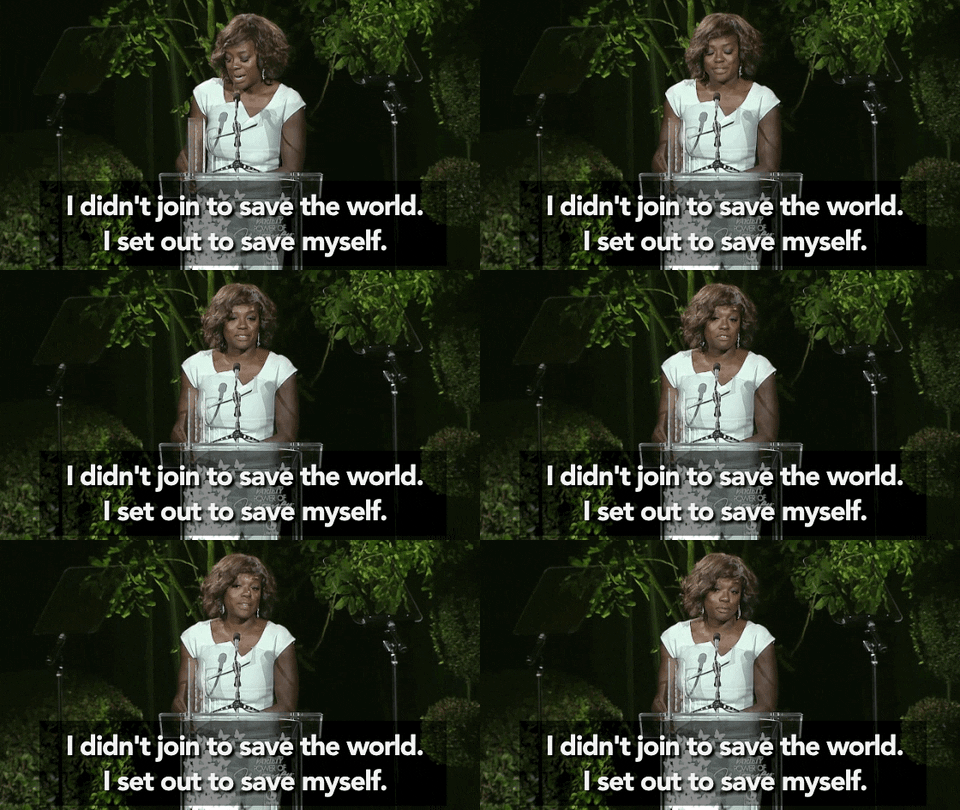
I've been busy. Which means that I haven't been responding to comments with quite the speed that you're probably accustomed to. By the time I post my once- or twice-weekly blogs, as well as select my Wednesday Word Hug, it's time to close the window on my computer and move on to other work. But I think of you all so often. "Haven't heard from Dandelion in a while. Wonder how she is," I'll think to my. "LilyLove hasn't been posting so often, nor has LLP. Hope everything's okay with them." And, as you all know, the list of BWC members goes off. Sometimes, searching for an old post to link, I'll notice a comment from a name I haven't seen in years. I'll smile because they don't need us anymore. That's cause for joy.
What's also cause for a deep joy in me is something else that happened this morning. I was clicking publish on the comments that didn't involve trying to scam you all into hiring hackers or spellcasters and I noticed a response to some comments I'd missed responding to on one of our Just Finding Out threads. I often miss those comments, tending to, most often, respond to comments on recent posts. The others, unfortunately, tend to get lost to time.
But Heartfelt was compelled to respond to Emily with a story of her own trauma and an assurance that everything Emily (and her spouse) were feeling was perfectly normal and also assurance that these feelings would pass. That time (and therapy) would work its magic and life would once again feel more stable. That wounds heal. That our hearts can remain open to love.
And watching this simple gesture – one heartbroken woman reaching out to a stranger via a computer screen reminding me why I continue to run this site, even as life tries to crowd it out. It's because of all of you who, over the years, helped each other heal. Lots of women who came here won't read this post because they're long gone. They're like me. Life has crowded out Betrayed Wives Club. And that's a wonderful thing. We should all hope for that day.
But that Heartfelt, who hadn't herself been here in a while, took the time to wrap another in a word hug, made me feel, yet again, so lucky to be among you.
We all get busy. And reaching out can sometimes feel scary. Sharing our stories can make us feel vulnerable and raw. None of us is under any obligation to write anything. This site is like a buffet -- take what appeals, leave what doesn't and don't feel as though you need to bring a dish. There's plenty to go around.
But for those who have made this site part of their conversation, please know how grateful I am for the role you play. Betrayed Wives Club wouldn't work without you. There would be no buffet if, to butcher this metaphor further, there was only my single casserole sitting there growing cold.
You all remind me, every single day, of the good that came out of my heartbreak. I confess I wasn't a huge fan of the sisterhood. Too many betrayals by too many sisters.
But you've restored my faith. You've taught me the power inherent in women helping women. We often say this is the club we never wanted to join. I can't say that anymore. Cause this club is one of the best things that's happened for me.
As Viola Davis says above, I didn't set out to save you guys. I set out to save myself. And it was you guys who saved me. Thank-you.
Pages
- Home
- Feeling Stuck, Page 22 (PAGE FULL)
- Sex and intimacy after betrayal
- Share Your Story: Finding Out, Part 5 (4 is full!!...
- Finding Out, Part 5 (Please post here. Part 4 is f...
- Stupid S#*t Cheaters Say
- Separating/Divorcing Page 9
- Finding Out, Part 6
- Books for the Betrayed
- Separating and Divorcing, Page 10
- Feeling Stuck, Part 23
- MORE Stupid S#*t Cheaters Say
- Share Your Story Part 6 (Part 5 is full)
- Sex & Intimacy After Betrayal Part 2 (Part 1 is full)
- Share Your Story
- Share Your Story Part 7 (6 is FULL)
Friday, April 12, 2019
Wednesday, April 10, 2019
Tuesday, April 9, 2019
Can You Ever Trust Him Again? It's a Trick Question
"I will never trust him again," I wrote in my journal. Over and over. In blue ink and black. "I will never trust him again."
You've probably said it too. Written it in your own journal. Said it to your therapist, your friends, yourself. To him.
A woman was recently asked on Twitter whether she believed she would ever trust her husband again after he'd been unfaithful. Her response? "I intend to spend the next 50 years finding out."
It sounds flip.
But what she's saying in the absolute uncomfortable truth.
You trusted him before and it turns out he was untrustworthy. So whether we trust him or not doesn't change his behaviour at all. It only changes us.
There are nuances, of course. I'm not advocating for total and absolute trust of a man who's revealed himself unworthy of trust. But I am pointing out that we don't really know who's trustworthy or not until they either betray us, or they don't.
And I'm making the case too that whether or not he is to be trusted is the wrong question. The right question isn't about him at all. It's personal:
Can I trust myself?
Because whether or not we feel safe in the world has far more to do with that question than whether others are trustworthy or not.
And learning to trust ourselves is something we have far more control over than others' actions. Trusting ourselves is about paying attention to what feels right or wrong, safe or unsafe, true or untrue.
Trusting ourselves is about personal integrity. And when we live our own lives with personal integrity, we'll be far more selective about those we share our lives with. We'll become impatient with the friend who gossips about other friends. We'll stop simmering in resentment with those who are consistently late and instead prioritize our own time. We'll notice when our guts or our hearts or our brains – our motherboards – set off alarms (whether barely perceptible or blinding red lights) in certain situations.
Trusting ourselves isn't like some sort of emotional armour that shields us from any cons, grifters, gaslights or garden-variety cheaters. But it does, nonetheless, offer protection. When we trust ourselves, we notice things. We pay attention to our inner pilot lights. We know who we are and what we stand for. And we know what we won't stand for. Trusting ourselves isn't hyper-vigilance. That's rooted in fear. Trusting ourselves is rooted in self-respect and the clarity that comes with knowing where the line is drawn and what we will do when that boundary is violated.
I don't know whether or not your husband will cheat on you again. I don't even know whether my husband will cheat on me again.
But I know this.
If anyone betrays me – whether the betrayal is large or small – I trust myself to respond in a way that honors and respects me.
And approaching my life – my marriage, my relationships, my work – from that place is far more predictive of joy than whether or not I can trust him. Whether or not he's trustworthy remains to be seen. So far, so good. And I have the rest of my life to find out.
You've probably said it too. Written it in your own journal. Said it to your therapist, your friends, yourself. To him.
A woman was recently asked on Twitter whether she believed she would ever trust her husband again after he'd been unfaithful. Her response? "I intend to spend the next 50 years finding out."
It sounds flip.
But what she's saying in the absolute uncomfortable truth.
You trusted him before and it turns out he was untrustworthy. So whether we trust him or not doesn't change his behaviour at all. It only changes us.
There are nuances, of course. I'm not advocating for total and absolute trust of a man who's revealed himself unworthy of trust. But I am pointing out that we don't really know who's trustworthy or not until they either betray us, or they don't.
And I'm making the case too that whether or not he is to be trusted is the wrong question. The right question isn't about him at all. It's personal:
Can I trust myself?
Because whether or not we feel safe in the world has far more to do with that question than whether others are trustworthy or not.
And learning to trust ourselves is something we have far more control over than others' actions. Trusting ourselves is about paying attention to what feels right or wrong, safe or unsafe, true or untrue.
Trusting ourselves is about personal integrity. And when we live our own lives with personal integrity, we'll be far more selective about those we share our lives with. We'll become impatient with the friend who gossips about other friends. We'll stop simmering in resentment with those who are consistently late and instead prioritize our own time. We'll notice when our guts or our hearts or our brains – our motherboards – set off alarms (whether barely perceptible or blinding red lights) in certain situations.
Trusting ourselves isn't like some sort of emotional armour that shields us from any cons, grifters, gaslights or garden-variety cheaters. But it does, nonetheless, offer protection. When we trust ourselves, we notice things. We pay attention to our inner pilot lights. We know who we are and what we stand for. And we know what we won't stand for. Trusting ourselves isn't hyper-vigilance. That's rooted in fear. Trusting ourselves is rooted in self-respect and the clarity that comes with knowing where the line is drawn and what we will do when that boundary is violated.
I don't know whether or not your husband will cheat on you again. I don't even know whether my husband will cheat on me again.
But I know this.
If anyone betrays me – whether the betrayal is large or small – I trust myself to respond in a way that honors and respects me.
And approaching my life – my marriage, my relationships, my work – from that place is far more predictive of joy than whether or not I can trust him. Whether or not he's trustworthy remains to be seen. So far, so good. And I have the rest of my life to find out.
Monday, April 8, 2019
Our lives are not just "befores" and "afters"
"Through her therapy she was learning that though it was agony remembering, it was a much better quality of agony than not remembering."
From The Guardian, "The tsunami survivor who lost her whole family"
I wanted a lobotomy. I wanted someone to cut out the part of my brain where the painful knowledge sat. Or give me amnesia, like a soap opera character, that erased the worst memories, the ones that pinned me to my bed like a still-living corpse.
The woman in the story, Sonali Deraniyagala, lot her family in, literally, one wave. Remembering for her is undoubtedly worse than it ever was for me. But, as I've written before, there isn't a painlympics. My pain counts. Yours too. (And yes, even his.) And so we learn from each other, including from a woman who, having lost every person she loved most in the world in one horrific tragedy, how to pick ourselves up and move forward.
For Sonali, and for me, healing came with remembering.
Not right away. At first, it was too painful to remember the births of my children, the holidays together, the laughter. Those memories felt like they belonged to someone else, to another life. To a life that I was wondering if I'd imagined.
But slowly, with time, I could let them in. The wedding album I'd relegated to the basement found its way upstairs again, ostensibly so my children could look at it but also because I could look at it too, without my stomach clenching. Or not clenching too much.
The photos I'd put in drawers, the jewellery I'd stopped wearing, the clothes that held memories, also made their way back into regular rotation. Not all of them. The chain of a diamond necklace remains, literally, in pieces somewhere at the back of my drawer. Certain clothes were bagged and dropped at a charity box.
And I brought my memories here.
As I shared my story, over months and years, I exorcised those memories of "before" and knit them seamlessly with "after". I had never imagined that my life would ever again feel like it flowed. Always, always I figured that "the news" as Glennon Doyle refers to it, would remain an interruption, a dividing line between "before" and "after". And I suppose, to some extent it does. But not nearly the way it did. It has become something akin to the "before" we had kids, the "before" we moved to our house. A marker of time rather than a marker of trauma.
I've often said that I have two wishes for this site. The first is to create community around the experience of betrayal so that nobody feels as though they're going through this alone. And the second is to assure everyone, whether you're hours from D-Day or years, that you will get through this.
Both are the absolute truth.
But the second requires a bit of heavy lifting on our part. It requires us to look square at our life and, with time, remember. To remember the good stuff and, yes, to remember the awful. To sit with the pain of remember that phone call, that text, that sudden knowing. To rest in the memory of your own strength through this. You're still here, right? That's courage and guts that you maybe didn't know you had. It's there. I promise.
Sonali Deraniyagala wrote her story and on those pages, she found healing. I too wrote my story, on this site and in my book. I've long advocated for the power of owning our stories, of reclaiming our memories and our truth. Betrayal challenges our perception of what's real and what's not. When we reclaim that – when we refuse to let others write our stories, when we insist on telling them with ourselves at the center – then our hearts again become whole.
From The Guardian, "The tsunami survivor who lost her whole family"
I wanted a lobotomy. I wanted someone to cut out the part of my brain where the painful knowledge sat. Or give me amnesia, like a soap opera character, that erased the worst memories, the ones that pinned me to my bed like a still-living corpse.
The woman in the story, Sonali Deraniyagala, lot her family in, literally, one wave. Remembering for her is undoubtedly worse than it ever was for me. But, as I've written before, there isn't a painlympics. My pain counts. Yours too. (And yes, even his.) And so we learn from each other, including from a woman who, having lost every person she loved most in the world in one horrific tragedy, how to pick ourselves up and move forward.
For Sonali, and for me, healing came with remembering.
Not right away. At first, it was too painful to remember the births of my children, the holidays together, the laughter. Those memories felt like they belonged to someone else, to another life. To a life that I was wondering if I'd imagined.
But slowly, with time, I could let them in. The wedding album I'd relegated to the basement found its way upstairs again, ostensibly so my children could look at it but also because I could look at it too, without my stomach clenching. Or not clenching too much.
The photos I'd put in drawers, the jewellery I'd stopped wearing, the clothes that held memories, also made their way back into regular rotation. Not all of them. The chain of a diamond necklace remains, literally, in pieces somewhere at the back of my drawer. Certain clothes were bagged and dropped at a charity box.
And I brought my memories here.
As I shared my story, over months and years, I exorcised those memories of "before" and knit them seamlessly with "after". I had never imagined that my life would ever again feel like it flowed. Always, always I figured that "the news" as Glennon Doyle refers to it, would remain an interruption, a dividing line between "before" and "after". And I suppose, to some extent it does. But not nearly the way it did. It has become something akin to the "before" we had kids, the "before" we moved to our house. A marker of time rather than a marker of trauma.
I've often said that I have two wishes for this site. The first is to create community around the experience of betrayal so that nobody feels as though they're going through this alone. And the second is to assure everyone, whether you're hours from D-Day or years, that you will get through this.
Both are the absolute truth.
But the second requires a bit of heavy lifting on our part. It requires us to look square at our life and, with time, remember. To remember the good stuff and, yes, to remember the awful. To sit with the pain of remember that phone call, that text, that sudden knowing. To rest in the memory of your own strength through this. You're still here, right? That's courage and guts that you maybe didn't know you had. It's there. I promise.
Sonali Deraniyagala wrote her story and on those pages, she found healing. I too wrote my story, on this site and in my book. I've long advocated for the power of owning our stories, of reclaiming our memories and our truth. Betrayal challenges our perception of what's real and what's not. When we reclaim that – when we refuse to let others write our stories, when we insist on telling them with ourselves at the center – then our hearts again become whole.
Thursday, April 4, 2019
The Shame of Secrecy. The Secrecy of Shame
If your family kept secrets and never talked about hard things, you grow up feeling a lot of shame and loneliness about struggling.
Healing comes in relationships with people who don't live like there's shame in talking about hard things.
And don't pretend not to struggle.
~notesfromyourtherapist, Instagram
The first person I called was my mother. And like good mothers throughout history she immediately and completely was in my corner. She expressed empathy, support and a rock-solid faith in me. She didn't vilify my husband but held him accountable. She held me, she listened to me and she was always, always on the other end of that phone when I needed her.
I was lucky.
Others, not so much.
I hear often from you about how abandoned you feel. Your mothers won't talk about it or you're afraid to tell them. Your siblings take sides or cast judgement. Your friends, in the interest of supporting you, insist that the only way to respond is to file for divorce.
And that's if you tell anyone at all. Far more often, we don't. We hold our secret close. And it poisons us.
It poisons us because secrets carry shame. Even if we know, in our heads, that we are not the reason he cheated. Even if we understand that people don't cheat because there's something wrong with their spouse, they cheat because there's something wrong with them. Because they're lost or afraid or lonely and they don't know how to feel those feelings and so they avoid and they distract and they lie to themselves and others.
Their secrets have poisoned them.
My family kept the secret of my parents' addictions. And because I was young, I learned that I should be ashamed. Why else would I not being able to talk about what was really going on at home. It must be shameful. It must be kept hidden. Nobody had to tell me that, of course. It was understood. And that silence, that secrets poisoned me for a lot of years.
When my mother got sober and began telling her story (she took her 12 steps seriously and wrote letters of apology and shared her story far and wide), I slowly began sharing mine. I was leery. In my twenties, at a time when there wasn't nearly the cultural conversation around addiction that there is now, I knew I was opening myself up to judgement. But what I've learned since is that no-one's judgement was harsher than my own. Nothing anyone ever said to me matched my own feelings of shame, that I still needed to wrestle with.
It has been a similar experience with my husband's infidelity.
I told my mother but very very few others. One of those others cast judgement, which sent me scurrying back into my silence.
And that's mostly where I stayed. Silent. And filled with shame.
Until I began telling my story here. And, over years, began opening up to friends. I was (am!) still careful about who I tell. Trust is earned, not assumed. And though I no longer feel shame about my husband's infidelity, there are parts of my life I keep private. And there's a difference between secret and private.
For instance, I don't widely share (except on this blog, in which I remain relatively anonymous) about my daughters' mental health challenges. There are people in my life with whom I'm close who don't know my eldest was hospitalized. I don't hide that. But I respect my eldest's wish to keep it, mostly, private. That's a choice rooted in healthy decision making. Not shame.
Similarly, though plenty know about my husband's infidelity in our city, many more do not. It was long ago. He has done much work. It isn't what defines him or our marriage. And so we, mostly, keep it private.
We haven't told our children, not out of shame but for many other reasons. We keep it private, something some experts such as Caroline Madden, a family therapist, supports and encourages. Others do not. Our choice.
I share my story when I think it can do some good. Either for me or for the person on the other end of it.
And that's where I hope you can all get to. I wish you an army of people in your life who can love you through this pain. Who can listen to you, without judgement. Who can see your pain and run toward it, not away. Those people are, sadly, rare. But their fear of your pain is rooted in their own shame and secrecy. It's a consequence of their own inability to talk about hard things.
Life is a marathon of hard things. If we never learn how to talk about them, we fail to learn how to really life. Authentically. Deeply. And too often, we don't heal from those hard things. We don't grow from them.
You get to choose what's private and what's not. But secrets? Exorcise those. Be honest about them, at least with yourself. Cultivate relationships with people who don't operate from fear but who are honest about their own struggles.
Find your family, built on honesty and a willingness to hold each other up.
Healing comes in relationships with people who don't live like there's shame in talking about hard things.
And don't pretend not to struggle.
~notesfromyourtherapist, Instagram
The first person I called was my mother. And like good mothers throughout history she immediately and completely was in my corner. She expressed empathy, support and a rock-solid faith in me. She didn't vilify my husband but held him accountable. She held me, she listened to me and she was always, always on the other end of that phone when I needed her.
I was lucky.
Others, not so much.
I hear often from you about how abandoned you feel. Your mothers won't talk about it or you're afraid to tell them. Your siblings take sides or cast judgement. Your friends, in the interest of supporting you, insist that the only way to respond is to file for divorce.
And that's if you tell anyone at all. Far more often, we don't. We hold our secret close. And it poisons us.
It poisons us because secrets carry shame. Even if we know, in our heads, that we are not the reason he cheated. Even if we understand that people don't cheat because there's something wrong with their spouse, they cheat because there's something wrong with them. Because they're lost or afraid or lonely and they don't know how to feel those feelings and so they avoid and they distract and they lie to themselves and others.
Their secrets have poisoned them.
My family kept the secret of my parents' addictions. And because I was young, I learned that I should be ashamed. Why else would I not being able to talk about what was really going on at home. It must be shameful. It must be kept hidden. Nobody had to tell me that, of course. It was understood. And that silence, that secrets poisoned me for a lot of years.
When my mother got sober and began telling her story (she took her 12 steps seriously and wrote letters of apology and shared her story far and wide), I slowly began sharing mine. I was leery. In my twenties, at a time when there wasn't nearly the cultural conversation around addiction that there is now, I knew I was opening myself up to judgement. But what I've learned since is that no-one's judgement was harsher than my own. Nothing anyone ever said to me matched my own feelings of shame, that I still needed to wrestle with.
It has been a similar experience with my husband's infidelity.
I told my mother but very very few others. One of those others cast judgement, which sent me scurrying back into my silence.
And that's mostly where I stayed. Silent. And filled with shame.
Until I began telling my story here. And, over years, began opening up to friends. I was (am!) still careful about who I tell. Trust is earned, not assumed. And though I no longer feel shame about my husband's infidelity, there are parts of my life I keep private. And there's a difference between secret and private.
For instance, I don't widely share (except on this blog, in which I remain relatively anonymous) about my daughters' mental health challenges. There are people in my life with whom I'm close who don't know my eldest was hospitalized. I don't hide that. But I respect my eldest's wish to keep it, mostly, private. That's a choice rooted in healthy decision making. Not shame.
Similarly, though plenty know about my husband's infidelity in our city, many more do not. It was long ago. He has done much work. It isn't what defines him or our marriage. And so we, mostly, keep it private.
We haven't told our children, not out of shame but for many other reasons. We keep it private, something some experts such as Caroline Madden, a family therapist, supports and encourages. Others do not. Our choice.
I share my story when I think it can do some good. Either for me or for the person on the other end of it.
And that's where I hope you can all get to. I wish you an army of people in your life who can love you through this pain. Who can listen to you, without judgement. Who can see your pain and run toward it, not away. Those people are, sadly, rare. But their fear of your pain is rooted in their own shame and secrecy. It's a consequence of their own inability to talk about hard things.
Life is a marathon of hard things. If we never learn how to talk about them, we fail to learn how to really life. Authentically. Deeply. And too often, we don't heal from those hard things. We don't grow from them.
You get to choose what's private and what's not. But secrets? Exorcise those. Be honest about them, at least with yourself. Cultivate relationships with people who don't operate from fear but who are honest about their own struggles.
Find your family, built on honesty and a willingness to hold each other up.
Wednesday, April 3, 2019
Monday, April 1, 2019
Betrayed Wives Club: Here's What I Know
I was recently invited by Samuel (find him on Twitter) to speak with him for his Overcoming Infidelity podcast, which you can listen to here – I'm on episode 3.
Samuel pointed out that my site is "safe space" for those who come, which is something I intended but something that I sometimes forget about. Until someone else notices and points it out.
So let me explain:
Like so many of you, after D-Day I turned to Google for...what exactly? I wanted someone to make sense of my messed-up life. I was desperate for answers, just like those of you who come to me via an Internet search for "why did my husband cheat?" and "how can I make the pain of my husband's affair end?" (Those key word searches break my heart, you guys.)
More than anything – and though I likely couldn't have articulated it back then – I sought community, a safe place where I could lay down my pain and trust that it would be held so that I could take a deep breath. I couldn't find it. Too often, I'd read something that triggered my shame, made me feel stupid, told me I was searching for unicorns.
So I created my own, which is where are you right now.
I wanted to create a safe space. I knew how terrifying it was to share my pain. With strangers! Maybe I'd be outed. Could I trust these people?
I decided to not include advertising, even though it would have been nice to subsidize the time I worked on the blog. But I didn't want a soul to come here and then find an ad for escorts or lube or anything else that might be trigger-y. I crafted each blog post to best share my own experience, noting that this was just my path. We are each free to choose our own, I wrote.
(Eventually, when I was considering whether to continue with my site or shut it down – the time required was impacting the time I had to pursue paid work – I decided on the Donate button, leaving it up to anyone who wanted to contribute. I absolutely value every cent that's been donated over the past few years since I added it. It makes my work feel...legitimate.)
But for all my writing over the past 12 years, for all the work of Esther Perel and Brené Brown and others who have worked hard to shift our conversation around infidelity to one of nuance and critical thinking, there remains this pervasive myth around cheating. Namely, that anyone who cheats on you will continue to cheat on you. Something that is patently untrue. And also, that anyone who stays with a cheater is basically asking for more of the same.
My anger flares just by typing those statements out. They're absurd. But they persist, largely because they trigger our deepest fears about our partners and ourselves. And fear, we all know far too well, is powerful. But these statements remain dominant in infidelity discourse because there's just enough truth in them that we can't dismiss them outright. Some cheaters do continue to cheat. And some women who stay with cheaters – those who haven't set boundaries or who don't insist on change – are, potentially, accepting more of the same.
And so we wonder: Is that us? Are we the idiots who'll be cheated on again? Will there be a chorus of "I told you so's" when we discover his second affair. His third?
It's just enough to keep us frightened, isn't it? Just enough to keep us silent.
But what's most surprising about those sentiments is that they often spring from the lips of other who've been betrayed. Others who've been hurt and, rather than process that pain, inflict it on others. But that, my secret sisters, is not support. We must never value being "right" over being compassionate. Our role isn't to tell another how to respond to her pain but rather to bear witness to it.
Betrayed Wives Club isn't about answers, it's about sitting with the questions. It's about giving you – me, all of us – permission to figure out what's right for us. Without blame. Without shame.
I haven't a clue what you should do (except, and yes I know I'm a broken record, set boundaries. And also love yourself. You are so so awesome. Really.)
The rest? Search me. I don't know. I can barely muddle through my own life.
And it's not my place, or anyone else's to tell you what's right or what's wrong or to predict your future. I wrote last week about being skeptical of easy answers.
Nothing about healing from infidelity is easy, whether you stay or go. But it can be simple. By that I mean:
•prioritize self-respect
•set boundaries
•trust yourself
Betrayal can destabilize everything we believe. But our worth – and our right to determine our own path through the pain – shouldn't be called into question by anyone.
Subscribe to:
Posts (Atom)


