Showing posts with label affairs. Show all posts

Thursday, April 27, 2023

On Accountability and Transformation


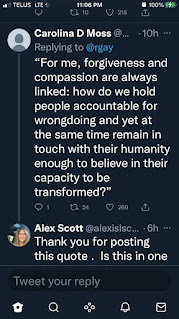
I screenshot this comment many months ago because I was so struck by how this question was framed:

 "How we do hold people accountable for wrongdoing and yet at the same time remain in touch with their humanity enough to believe in their capacity to be transformed?"

It's the question that's a part of the heart of this site. (I saw a part because I think the larger part of the heart of this site is to provide a safe space for betrayed wives to heal and chart out their next steps.) 
There are other sites, of course, that traffic in vitriol, in revenge. There are sites that peddle forgiveness. I like to think that this site does neither — I have tried to create a space in which we acknowledge the deep deep wound of betrayal while at the same time recognizing that a cheater isn't necessarily a monster. But neither is a cheater automatically deserving of our forgiveness. I've tried to find a path somewhere between the two where we can keep our focus on our own pain, our own healing, while — if we choose to — remaining in touch with the humanity of the person who's caused the deep wound. 
Because I remain convinced that, as upside-down as it seems (and I acknowledge that there are exceptions), most cheaters are trying to fix something broken inside of themselves. And whether or not you're interested in rebuilding a marriage with the same person, it can accelerate your own healing if you're able to remain in touch with the humanity of the person who caused your pain.
The reason is simple: In order for us to be able to extend true compassion to someone else, we need to know it ourselves. I had long been a harsh judge of others. I had no time for liars, for scoundrels, for cheats. But when I discovered I was married to someone who was all three, and that I lacked both the energy and the bandwidth to leave right away, I had to try something else.
I wrote about it in 2015: 
"Transformation, I've discovered, isn't a bolt of lightning from the sky. It wasn't magic.
For me, transformation was showing up each day, slowly opening my heart to the possibility that I could handle this. That I was worth fighting for. Not someone else fighting for me but ME fighting for me. That I was enough, just as I was. That I had always been.
And within that transformation, there were many many gifts. Much suffering too. But that, it seems, is where transformation takes root."
By truly coming to believe that I had value, I accepted that my husband had value too. And — it shocks me still to know this — I came to believe that she had value too. That she cheated with a man she knew was married because she had no self-worth. Where had she learned to live on crumbs? 
None of this is to argue that you need to stay married. That you need to forgive him. That you need to forgive her.
It is, however, to say that if we can learn to thread that needle — to hold him accountable for wrongdoing and yet remain in touch with his humanity — we learn healthy boundaries. We learn our own worth and that of others. 
When we believe in others' capacity to be transformed, even in light of wrongdoing, we create the conditions for our own transformation. 

Wednesday, May 25, 2022

Stuck Between "Now" and "Not Yet"

I had never heard of Jen Hatmaker and remain somewhat mystified how she came to my attention but I think it was around the time her marriage was falling apart. I didn't recognize the name but I recognized the story. A couple everyone seemed to love – a public couple – was announcing divorce, shocking those who knew of them. Hatmaker herself issued a statement along the lines of being blindsided, not wanting this, pleading for privacy, and so on.

Ah, I thought to myself. He cheated. 

And though Hatmaker's language remains somewhat cagey, you, my dear readers, know as well as I do how to read between the lines. He cheated. Of course, he did.

But though I still don't know a lot about Jen Hatmaker and am not part of her cool Christian girl club (no disparagement – just not my scene), I've become quite fond of her as a public figure. For one thing, she's funny. She's honest about who she is. She's eloquent. And recently, she was on Glennon Doyle's We Can Do Hard Things podcast at which point she made reference to that stage – one we're all familiar with – of being caught between "now" and "not yet". 

"Now" is what's happening. It's the gut punch of D-Day. It's the sleeplessness, the churning anxiety of "what if he's still cheating? How will I know?", it's the mask we wear to work. It's the "how long will I feel like this?". 

"Not yet" is that water hole up ahead, the one that promises to quench our thirst, the one that keeps being just a few steps (a thousand steps!) beyond where we are right now. 

You'll reach "not yet", I promise you will. And I know how agonizing it is to feel stuck somewhere in between. Maybe the pain isn't quite so acute. Maybe you've decided to stay and it seems to be working. Maybe you've decided to leave and you're settling into this new reality. Maybe you're still figuring out your next right step. But you don't feel there yet. You don't feel like this is in the rear-view mirror. You haven't made it to "not yet". Not yet, anyway. 

Be patient with yourself. Be patient with your shattered heart. Stop periodically and check in with yourself. Am I where I want to be? Or, if that's impossible, am I where I can find a way to be my best self? Sometimes we can make the choice and sometimes that choice is forced onto us. But we can still honor ourselves. Jen Hatmaker makes that clear too. That we can make healing our focus and that, no matter how much we may have not chosen our new reality, we can center ourselves and keep our hearts soft and find joy in the world. 

Let those of us further ahead beckon you forward. Let us be the light that helps you see your way through. Though I'm not as active on this site as I was (when we get to "Not yet", infidelity becomes something that happened long ago), I do still read your comments. And I do hope this site remains a safe space for all of you to find community and the reassurance that though you might feel stuck right now, "not yet" is possible, indeed a promise, for all of us.

Friday, April 30, 2021

When the Past is Alive

 Most of us look at our past as...the past. As in yesterday's news. Been there and done that. Maybe we learned a lesson or two.

But for some of us, those of us marked by trauma, the past isn't behind us. Or at least, it's not always behind us. Sometimes it's right beside us. Sometimes it's right inside us. 

The past, for some of us, is alive. That's how Bessel van der Kolk describes it in his bestselling The Body Keeps the Score. And that's how he explained it to Kate Bowler on her amazing podcast, Everything Happens. 

If you haven't watched Bowler's TedTalk, please do. Right now. It details how Bowler was diagnosed with cancer. Far too young. Far too frightening. And that experience took her out of her conviction that everything happens for a reason and left her stranded at everything happens. 

We know that place, don't we? Betrayal. The place where awful things can happen for absolutely no good reason at all. Or at least no reason that makes sense, that we're willing to accept. And no, "my husband is an idiot" isn't a palatable reason for infidelity. Neither is, "to teach us something," even if this pain does, in fact, often teach us something. 

But back to Ver Der Kolk. He was on Bowler's podcast to talk about trauma, which is his speciality. Bowler herself experienced trauma when sick, when she discovered that the doctors she turned to for healing weren't available to her unless her insurance company said they were. She felt betrayed and abandoned by a system she had believed had her back. 

Yeah, I saw the parallels too.

And I felt such recognition when van der Kolk said for those of us who've experienced trauma, "the past is alive". The way he describes it is that trauma shows up in our bodies in a way that feels immediate. We're walking along the street and notice a man who reminds us our abusive father. We don't think to ourselves, "that guy looks like Dad", our bodies flood. Our breath becomes shallow. Our vision narrows. We want to fight. Or flee. Or freeze. Sometimes, when it's someone with whom we have a relationship, we want to fix. 

All trauma responses. All alive. All immediate.

As van der Kolk puts it, "Before too long everything sort of starts disintegrating because your whole body keeps behaving as if you’re back there again."

Back there again. In the past. Except it's our present. And so we dissociate from our bodies. Our brain tries to tell us we're safe. The danger is past. But our bodies are saying, no way. Don't believe you.

Reconnection is the way out of this past-present. Putting our brains and our bodies back on the same team. For van der Kolk, that path is through movement. Yoga. Martial arts. Dancing. It's about being alive, he says: "...your body is both a source of pain and a source of pleasure. So if you if you cut off sensation your body, which many times traumatized people do somewhat successfully, you also cut off your avenues for pain and for pleasure and for change reality and feeling satisfied and feeling alive."

The key is re-embodiment. Finding our way back to our bodies. Integrating those trauma experiences into our present so that we can examine them as what happened (past), not what's happening (present).

I turned to EMDR many years ago, which is something else van der Kolk recommends. It's feels very hocus-pocus-y but, let me tell you, it worked for me and for so many others with whom I've spoken about it. 

In the meantime, be gentle with yourself. Find something that reconnects you with your body. Yoga worked for me though there were times when, on the mat, I felt so vulnerable and naked and scared. Stay with it. Breathe through it. Running also worked for me. This is me getting stronger. Faster. So did hiking. I see. I smell. I hear. 

And when your husband is 10 minutes late and you go into that nononononononono, where is he this is happening again (yes, I've been there), try to recognize it as a trauma response. It is your body hurtling you through time right back to where the injury happened. Try and feel your body right now. And, if you feel safe enough with your partner, tell him what happens to you when you're in that trauma response. Try to enlist him to support you. This isn't about you being unreasonable or refusing to "move forward". This is about you experiencing a trauma response. This is about you trying to find safety. This is a physical manifestation of your wound. It is, until you heal, beyond your control. 

I want that for everyone who comes here. I want all of us to learn how to find that safety in our own bodies. Then and only then can our trauma truly be something that's in the past. 


Monday, April 19, 2021

"How do I do this?": My Letter to a Betrayed Wife

Every day, there are new voices here. Voices of pain and bewilderment and rage and confusion. Voices that sound so much like my own so many years ago. Yesterday, I read a letter from a woman whose husband spiralled into a twisted, dangerous relationship. His story sounded a lot like my husband's. One of shame and addiction, compartmentalization and pain. 

At the end of her story, she asked me, all of us, "How do we do this? How do I do this?" It's the question, isn't it? It's the question at the heart of our pain, no matter what actions we take – stay, go, figure it out minute by minute: How do we do this?

And it's a question I feel that I can answer. But I did do this. And I've been part of thousand and thousands of other stories, a witness to how you do this.

And so, here's my answer. I wanted to share it because, although her situation is specific to her, her pain and confusion is something we all know. I share it in the hopes that it might help another: 

You ask "how do we do this...how do I do this?" You're doing it. You're doing it right now. When you're crying and when you're not crying. When you're tucking your kids into bed. When you're having better sex than you've had before. When you're afraid and when you think 'hey maybe I've got this'. You're doing it.

And that's how you'll get all the way through this. You will continue to prioritize yourself. You will continue to interrogate how you betrayed yourself and why, how you kept trying long after it was clear that he was hurting you. And you will learn from that. You will discover a reservoir of strength you never imagined you had and you will continue to draw from that. And each day, you will ask yourself -- either loudly or quietly -- is he continuing to deserve this second chance?
And if the day comes that you decide that you simply cannot remain in this marriage -- no matter how "good" he's being -- then you will honor yourself and get out. But if you discover that time and hard hard work is helping you both build a stronger marriage, then you will honor yourself by staying.
You have already endured the worst pain any of us can imagine – the loss of a child. I promise you that you will get through this too. Feel the pain because it's the only way I know to get through this. Bottling up the bad stuff only means we bottle up the good stuff too. Life is all of it. You are going through the pandemic and all the misery and anxiety that provokes while also experiencing the agony of betrayal. But here you are! Doing it. Loving your children. Extending grace to the guy who broke your heart.
As for the AP, she is not even worth the energy it takes to think of her. She is so damaged. An empty shell. Her punishment is being her. With her kids who see through her, her husband who discarded her, her career that she uses to prey on others. Yuck.
Your husband? I have empathy for him. I think he made a horrible horrible choice when he crossed that line with this woman but I see it not unlike someone handing him meth for the first time. He's responsible for himself, of course. He's not a victim. But his own pain blinded him to anything else. Hurt people hurt people. His job is to redeem himself. To become the man you always believed him to be. To be the father he wasn't for too many years. If he's anything like my own husband, his punishment is the knowledge that he hurt the people he loved and who loved him most in the world. I personally wouldn't want to live with that knowledge. It takes guts to face that, to live every day facing the pain in his family's eyes and still show up and do better. He's no hero, of course. He's human. And he made a horrible mistake.
You're going to be okay. I promise you that. Your gratitude for what you have will keep your head above water and your ability to nonetheless feel the pain and grief for all you lost will keep your heart soft.

Tuesday, March 30, 2021

Boundaries. Again. Because we (I) still struggle to set them...

I don't know about you but no matter how much I recognize the value in and need for boundaries, I still struggle. Years and years of being a pleaser has made "sure, I can do that" or "that's okay" my reflexive response to pretty much anything. You didn't have time to do that one thing I asked you to do? "That's okay." You need me to finish up a job for you? "Sure, I can do that."

Just this morning, I agreed to pay $40 at the dentist for a fluoride treatment that I kinda think is a gimmick because I wanted to be agreeable. Dammit, right? 

I'm getting better. I'm learning to build in a pause before I respond. Though it almost pains me, I now (mostly!) say, "let me think about that" when I'm being asked to do something that I'm not sure I want to. Too often, I don't know what I feel about something until I sit with it. My desire to please others remains, in the moment, stronger than my desire to please myself. But if I give myself that moment, if I allow myself time to check in with myself, then I remember: My job is to keep myself safe and my relationships free of resentment. And I can't do that when I'm agreeing to things that are disagreeable to me, or when I'm letting people off the hook for letting me down.

And so, here we are again: Boundaries.

Let's revisit what boundaries are not:

People think boundaries are a wall or moat around your heart, but they’re not

~Brené Brown

So what are they?

Good boundaries are a drawbridge to self-respect.

~also Brené Brown

Put another way, boundaries are about behaviours, not people. 

Put another, another way: Our problem isn't with the people in our lives, necessarily. It's with what they are/are not doing. And when we keep our focus on their behaviour and not on them personally, it's a lot easier to understand how to keep ourselves safe and to have the necessary conversation. These people can still be welcome in our lives but we can put limits on what we will and will not tolerate from them.

What's more, boundaries can change. What feels unacceptable to you right now (going to your husband's company BBQ because he cheated with his assistant) might feel acceptable in a year, or two, or three. In my case, I put limits on how often I saw my husband's family after D-Day. I found them critical and cruel and I decided I no longer would put myself through that. With time, I was able to see them more often while still respecting my limitations.

Boundaries confuse a lot of people because they feel dictatorial. Or selfish. But let's let Brené Brown's words be our guide. They are not a wall or a moat, they are a drawbridge to our self-respect. What do you need to be respectful of ourselves? 

•People may not _______________ (For me: People may not lie to me or be dishonest by omission)

•I have a right to ask for ________ (I have a right to ask for honesty)

• It’s okay for me to _______________ (It’s okay for me to say no to things I don't want to do or to take time to figure out what I want to do)

What might you add? I have the right to ask for...what I need to heal (counselling, a separation, a babysitter for time away). People may not...consistently be late. It's okay for me to...prioritize my needs.

It's hard if you don't have a lot of practice. And far too many of us have spent a lifetime squelching our own wants and needs to the point that we often can't identify what ours are. What makes me happy? Well, when everyone else is happy. Sad, huh? 

But, I'm learning. Slowly. But I'm learning. 


Stay tuned for a post on consequences. What they are and what they're not. Inspired by a Twitter conversation!


Sunday, March 22, 2020

From the Vault: That In-Between Place

As we all self-isolate and quarantine and do our best to NOT hoard toilet paper and hand sanitizer (please!!), I'm conscious of just how uncomfortable this state is, this state of in-between-ness. It's like we're all holding our breath, waiting to see what comes next. We have no blueprint for this, nothing we can compare it to, though we try. It's like 9/11, except it's not. It's like wartime. Except it's not.
And so we all...wait. We wait for news, we wait for leadership, we wait for something that makes the ground beneath us feel solid again, instead of this constant shifting. 
Waiting can be an important stage. Growing somewhat comfortable with discomfort is an important skill to learn. But it's not an easy one.
And so, as we all wait in this in-between place, I'm reposting this in the hope that it reminds us all that to feel uncertain is human. But so is it human to need to feel part of a community. We remain here, your invisible sisterhood (with a few brothers too!):

I've been spending a lot of time lately looking forward to when this is over. "This" refers to my father's recent fall, subsequent hospitalization, and return home with the support of what seems like a staff of 20. My world has been upended and my days are spent dealing with catheters, organizing nurses, planning meals and fretting – constant fretting – about the future. At 88, my dad isn't likely to bounce back. If we're lucky, where he is now – able to walk with a walker, decent long-term memory but shaky short-term – will hold. If we're lucky, he'll be able to continue to live in his home on the lake, his piece of paradise.
If we're lucky, "this" will be over soon and we'll settle back into normal.
This is that horrible in-between place. When the future is shadowy. When the present isn't quite a crisis but it isn't our normal.
The thing will living in that in-between place is that we're loathe to accept it. Not surprisingly, intolerance of uncertainty is linked to anxiety and depression. I squirm with discomfort. This is unacceptable. I want to know what's next. This in-between place is full of uncertainty. And I, like most humans, will take certain misery over uncertainty any day of the week.
It's this loathing of the in-between place that drives so many of us to make decisions before we're ready, to force our partners into decisions before they're ready. Just go, we demand, in the face their reticence to commit. I'm outta here, we declare, in the face of our own pain.
Thing is, we're taking that pain along with us. It doesn't vanish – poof! – just because we walk away from the discomfort.
I'm reminded of the time I told my now-husband that I was ready to get married. I was so convinced that he adored me, that he was just holding his breath for me to declare my readiness, that I was stunned when his response was lukewarm. So hurt was I that I announced that, clearly, this relationship wasn't what I thought it was and I was calling it quits. I went from "I'm ready to marry you" to "I'm breaking up with you" in about five minutes flat.
He asked me to give him time. He asked me to spend some time in that in-between place while he decided what he wanted. "You've clearly been thinking about this," he said. "I haven't. I love you and I love being with you but I haven't been thinking about getting married. Please let me have that time now."
I agreed, mostly because of his dog, who I couldn't imagine breaking up with.
And then, because I know myself, I decided to run a marathon. I knew that sitting in that in-between place, where I had no control over how things were going to play out, where I had to just live with uncertainty, would feel excruciating. And so I ran. Each day, I ran. Hours. And hours.
I got stronger physically. And I got stronger mentally. As I ran, I thought. About what I could control and what I couldn't control. (Incidentally, there's research that shows reading novels helps us get uncomfortable with uncertainty because we don't know how they'll end. I could have saved myself a whole lot of blisters and chafing if I'd just held a reading marathon instead.)
When I crossed that finish line, four gruelling hours and six excruciating minutes after starting, my then-boyfriend and his dog were there. I was thrilled to see them. But I realized that I didn't need his answer. Not right then. I'd become okay in that in-between place. It hadn't been as scary as I thought because I could control me. I was going to be okay no matter what he decided.
We spend a lot of time in that in-between place after betrayal. And, of course, it's complicated by the pain. But leaning into that in-between place – and yes, perhaps alleviating some of the discomfort with an activity that reminds us of our strength and our determination – can change everything. It can prevent us from making compulsive choices. It can shift our focus to what really matters.
As I cope daily with this in-between place – listening carefully each morning when I call my dad to signs of pain, or of confusion – I'm increasingly aware that in-between is where we spend much of our lives. And if all we're doing is holding our breath until it's over, we're missing out on the lessons it holds. To trust ourselves. To take care of ourselves. To be patient with ourselves and others.
My dad is also in that in-between place. But if I'm so focussed on my own discomfort, I can't see his fear. And so I try to make space for each of us and our enormous feelings. The in-between place is big enough for all of it.

Friday, November 22, 2019

Your Rights in the Wake of His Wrongs

I have the right to ask for what I want and then choose how I will respond if you can’t or won’t give it to me.
~ Iyanla Vanzant


My baby girl is nursing a broken heart. Like a whole lot of 16-year-olds dealing with her first heartbreak, she's trying to figure out what went wrong. And what she's figured is this: By setting boundaries and by asking for what she wanted (she asked for more regular contact when she and her beloved were apart instead of the 48-hour silences), she was accused of being "emotionally manipulative."
"Am I, Mom?" she asked. 
No. She's not. 
She's wiser than her years and though this was her first romantic relationship, she's always had a strong sense of herself and her boundaries. (I've learned a lot from her, incidentally, about setting and keeping boundaries.)
But we know this about boundaries, don't we? That when we ask for what we want/need, others, who don't want to give us what we want/need, will try and convince us that what we're in the wrong. That we're asking for too much. That we're too sensitive. That we're manipulative. In other words, they will respond with counter-moves in order to get us to back down, to make ourselves small, to keep the peace.
To which I say, hell no.
And to which I said to my sobbing daughter, hell no. Your job is not to make yourself small to make others happy, to prioritize others' comfort over your own.
That said, her ex was completely within her rights to say 'no' to more contact. She's allowed to have her own needs/wants. But what was unkind and wrong was the accusation of emotional manipulation. 
And far too many of us accept fault when all we're doing is stating our needs.
As Iyanla puts it, clearly and succinctly, "I have the right to ask for what I want and then choose how I will respond if you can't or won't give it to me."
Which means,  you get to ask him to stop going out for a beer with his friends if it makes you uncomfortable in the wake of cheating.
He gets to say 'yes' or 'no' but his choice makes his values clear and you get to decide what to do with that information.
You get to ask him to move jobs if his affair partner works with him. You get to ask him to seek help for his addiction(s). You get to ask him to give you any/all passwords to any/all electronics.
See the pattern?
You get to ask him.
He gets to respond.
And then you get to choose what to do with that information.
Here's what you don't want to do:
Ask him for what you want/need.
He refuses.
You ask him again. You beg. You plead. You explain.
You sulk. 
Nope.
You are a grown-ass woman who is entitled to ask for what she needs. And then determine what to do with his response.
It's when we expect him to read our minds that things go off the rails. It's when we're afraid to set boundaries that we get into trouble. It's when we don't prioritize our own wants/needs that resentment takes root.
It's not easy, especially if you've spent a lifetime staying small to keep others comfortable.
But this is the time to say 'no more.' 
I have the right to ask for what I want and then choose how I will respond if you can't or won't give it to me.
It's that simple. And that hard.
And that necessary.

Tuesday, July 23, 2019

How to Stop Doing Things That Feel Impossible to Stop

The shame might begin even as we boot up our computer and key in the words. Or we might feel nothing. Like we're on auto-pilot. Numbed by exhaustion and despair and terror.
But here we are again. Stalking the Other Woman's Facebook profile, checking out her Instagram. Our heart aching, our stomach in knots, our eyes rolling at the pithy quotes she posts about destiny, or scanning her face in photos for any sign that she's miserable or happy or is feeling remotely accountable for the pain she's wrought. What are we looking for exactly? We hardly know but that matters not at all.
And when we're done...here comes the hangover. The regret. The I swore I'd stop doing this, the I know this only makes me feel worse, the what's wrong with me that I can't control myself?
My D-Day took place before social media was as ubiquitous as it is now (be grateful for small mercies, right?) but that didn't stop me from driving past her apartment, Googling her name, casually listening at work functions for any mention of where she was and what she was now doing.
Even though I knew it would cause me pain. Even though I knew it did nothing to move me forward. Even though...
It gets a lot of us stuck, doesn't it? This obsession with...something. Rifling through Visa receipts, checking his cell phone messages, constantly alert for the threat, terrified of being blindsided again.
And we feel utterly helpless to stop it. Even when we know we should. 
A long time ago, Steam was terrified of flying. It's hard for me to even imagine as she's rarely in one place for long these days, constantly flying hither and yon. But her inability to just get on a plane was getting in the way of a lot of things – her career, for one. Her far-flung friendships. Her sense of independence and agency. She reached out to a guy who swore he could rid of her fear and she was just desperate enough that she went for it. Either the guy was a total grifter or it just might work. 
She told me this story one time when we were talking about getting unstuck from post-D-Day behaviours. And she'd been using a lot of what she'd learned that got her ON a plane to get her OFF stupid behaviour that was getting in the way of healing. 
So I asked her recently to share with me exactly what this guy taught her. It's deceptively simply, though a lot of behaviour modification techniques are (the elastic band on your wrist, the STOP sign). And so I share it here with the hopes that it gets you unstuck. That it gets you ON the metaphorical plane that takes you where you want to go.

It's all imagery, explains Steam:
In your brain, picture a photograph in your back pocket. It's a crumpled up Polaroid of you as an old woman sitting on your dilapidated porch in a rusty old chair. You have been so afraid of something that happened long ago that you've never managed to move on. You've remained there as life decays around you. You have nothing to add to any conversation. You stew in your sadness and bitterness. No-one wants to hear your story again.
Awful, isn't it? Painful.
Take out that mental photo periodically and look at it. When you feel paralyzed. When you're about to do something that you know isn't moving your forward but is rather keeping you stuck. Is that woman who you want to be? Forever? Didn't think so.
Now...
Pop a DVD in your brain and watch it as long as you want to. It shows you living after betrayal. You look incredible. You have people around you who love you. You've travelled. You've celebrated milestones. People enjoy being around you. They want to hear your stories, see your pictures. You've led an incredible life. 
Who do you want to be? 

Every day we make a bunch of choices. Eat this for breakfast or that. Put on these clothes or those. Take this route to work or that one.
Those choices apply to everything. Pour one glass of wine or another. Stalk her Facebook page or go for a walk. That's really all Steam's "Flying" guy taught her. To choose which woman she wanted to be.
Who will you choose today?

Monday, July 23, 2018

Why Can't I Forgive Him?

"In order for forgiveness to happen, something has to die."

Brené Brown was sitting in church when she heard her pastor utter those words. He had been speaking about counselling a couple on the brink of divorce after discovering her husband's affair. Brown had been wrestling with the idea of forgiveness for her book, The Gifts of Imperfection, and had ultimately taken the chapter about forgiveness out because she just couldn't get clear on it.
Those words were like an awakening. Because she realized this:
Embedded deeply in forgiveness is grief.
Think about that.
I always thought of forgiveness as something that people who weren't burdened with resentment and anger offered freely, then moved blithely into the rest of their lives. I would watch television shows (which is where so many of us children of dysfunctional families think we're finding reality) in which a sibling would wrong another sibling, but it would always end with an apology and the response: "I forgive you." And then all would be forgotten.
It took me years to realize that forgiveness doesn't really work like that, especially when the transgression is deep and painful.
I would wonder what was wrong with me that, even with my husband apologizing around the clock for his betrayal of me, I felt incapable of forgiveness. Surely those people were more spiritually evolved than I. They were simply better people. There were times in those early days that I didn't hate him. Brief moments when I could imagine not leaving. But mostly, I cried and simmered in resentment. I wasn't ready to leave but I hated staying. Forgiveness? Didn't that mean I was putting all this behind us? Didn't that mean I was okay with what he did? Didn't that mean I could never bring it up again?
Forget that.
I still wonder if I've "forgiven" my husband. I confess I'm not entirely sure what that means. I'm with him and happy to be. I trust him as much as I trust anyone who has revealed themselves capable of deception, which is the same as saying, I trust him as much as I trust anyone. His cheating is part of our story but only part. We rarely speak about it. I no longer use it like a sword, a way to cut him when I'm hurting.
Forgiveness though?
Maybe.
I've certainly grieved, which, as Brown says, is a key part of forgiveness. Something definitely died. A lot of somethings. My sense of safety. My idea of who he was. My idea of what my marriage was. My dream of doing marriage "right" (which says a whole lot about me, which I've had to wrestle with). My "perfect" family. A veritable graveyard of dreams.
And I had to grieve it all. Year by year. Tear by tear.
So maybe I have landed in this place of forgiveness. I've accepted that my husband is more than the worst thing he ever did. I admire and respect how hard he's worked to become a better person, how painful it was for him to face down his own demons. Plenty died for him too. His fantasy of his perfect childhood. His mythological martyr of a father. He had his own grieving to do.
I'm with Brené Brown on this one. Forgiveness is impossible without working through grief.
It never surprises me when one of our secret sisters washes up on these shores and begins her comment with, "I've forgiven him but I feel stuck."
Forgiveness looms large for so many of us – like this holy grail we feel we need to grasp.
But maybe we're looking at it wrong. Maybe forgiveness isn't something we bestow but rather something that is bestowed on us when we've worked through our grief. Maybe it's not something we feel but rather a place we arrive.
I had always thought forgiveness came easily to those more emotionally generous and loving than I. So did Brené Brown. It was only when she viewed forgiveness through the lens of death and grief that it clicked for her. There is nothing, she says, more generous than working through grief to get to forgiveness.

Monday, May 28, 2018

From the Vault: When You Feel Powerless

I'm finishing up my BWC survival guide (stay tuned!) and am completely tapped for time these days. With that in mind, I'm be re-posting some of my more popular posts. 


************************************

"Arrange whatever pieces come your way."
~Virginia Woolf

Most of us live in a sort of delusion that we have far more control over our lives than we do. It's an easy delusion. There's often not so much evidence that we're wrong. At least until the lump turns out to be malignant. Or our "good" kid starts stealing money to buy drugs. Or a fender bender leaves us with chronic pain that no amount of physio can fix.
Or until our spouse, the person we counted on to predictably keep the vows he took five, 10, 20 years earlier turns out to have been lying to us for five months, 10 months, 10 years.
Our delusion of control becomes clear. And it's terrifying.
But here's what we know: We haven't changed. And what we could always control – ourselves – is still what we can control. And what we couldn't ever control – everybody else – is still what we can't ever control.
And that, my dear soul-warriors, is good news.
It might not feel like that at first. At first, it might feel like horrible news. The worst news. How the hell are we supposed to move forward in a world where anybody can do anything at any time? Who knows what chaos will ensue? Who knows if he'll stop seeing her? Who knows if she'll respect "no contact"? Who knows if this will happen again?
Nobody. That's who knows. Nobody.
And nobody ever did know.
We were deluding ourselves.
Life, for the most part, is a game of weighing the odds. Do I think this person is trustworthy? Does this person have a track record of keeping promises? Of being fair? Of being reasonable? The emotionally healthy among us weigh this carefully. The less healthy among us (ahem, myself included) were taught to ignore those calculations. To give second and third and fourth chances. To pay attention to the apologies and ignore the original injury. To see the smile, not the lie.
A lot of us responded to a chaotic childhood with what the psychologists call "magical thinking", which is to say that we believed we had far more power than we did. We thought we could control things that we couldn't.
But even those with idyllic childhoods suffer the delusion of control. It's a way of surviving in a chaotic world where, frankly, anything can happen at any time. A bus can come careening around the corner and flatten us. Our child can develop debilitating mental health issues.
To put it in the vernacular, shit happens.
But.
But...we can always control our response to what life throws our way.
And, let me say it again, this is good news.
We have power though it might feel as though we don't.
We have the power to decide what it is that we will tolerate in our marriage after betrayal. We have power to carefully consider the consequences of a partner's deception, or continuing deception after we've agreed to give them a second chance.
We can make calculations, perhaps with the help of a therapist who's more clear-eyed than we are. We can determine what we want the rest of our life to look like if our partner cannot or will not become someone who deserves a second chance. And we get to decide what that looks like. We get to determine what our second chance consists of. Do we insist they get therapy? Do we insist that they attend a 12-step group? Do we insist upon treatment for their depression/addiction/anxiety/ADHD/impulse control/whatever? Do we insist that they steer clear of "friends" who enabled the cheating? As Steam puts it so perfectly, "My heartbreak, my rules."
It won't be easy. The right decision isn't always the easy one, though a lot of us also buy into the delusion that if it's the right decision, it will "feel" right. Nope. Not if we're accustomed to a lifetime (or even a few years) of not paying attention to our instincts. It takes practice to trust ourselves. It's a muscle that needs developing.
But that, my fierce soul-warriors, is where your power rests. In the knowledge that you have what it takes to keep yourself safe. In the recognition that you control you and nobody else.
And, one more time, that is good news. 

Tuesday, March 27, 2018

What if his affair really had nothing to do with you?

"Sometimes when we seek the gaze of another, it’s not our partner we are turning away from, but the person we have become. We are not looking for another lover so much as another version of ourselves. ... So often, the most intoxicating “other” that people discover in an affair is not a new partner; it’s a new self."
~Esther Perel, Why Happy People Cheat

Those words would have made me spit with anger if I'd read them in the early days following the discovery of my husband's affair. So I can imagine how more than a few of you are feeling right now. "Who the hell cares if he's discovered a 'new version of himself'," I can hear you yelling at your computer. "I am destroyed by this." 
And yes, it can be painful to hear some of the rhetoric around how affairs can help some cheaters get in touch with their own pain, or about how an affair can actually deepen a marriage. No matter that it's true. Who cares when my own heart is shattered! Why couldn't he get in touch with his pain without hurting me?
I hear you. And I agree. Just because he was so messed up that he thought he could find salvation in the arms of some woman with a trunk full of her own emotional baggage, why do I – and my children – have to pay the price? 
Fair question. And the answer, unfortunately, isn't very satisfying. Life isn't fair. Sometimes we are asked to show up for things that we didn't ask for. Often we are delivered situations that just suck. 
This, clearly, is one of those times.
And yet.
And yet, there's so much truth and freedom in what Perel is saying that if you can find the space in your shattered heart to even consider it, it just might change everything.
Because the thing with infidelity is that our first response, our knee-jerk response, is almost always to point the finger at ourselves. What is wrong with me that he would cheat? What does she have that I don't? Even those of us who are more charitable with ourselves can still find themselves wondering how they could have been so stupid as to miss that their partner was cheating. 
It's all about self-blame. It's about thinking we could control way more than we can actually control.
It's about thinking his affair was about us. When it wasn't about us at all.
It defies logic, doesn't it? How can he cheat on us and yet it has nothing to do with us? Of course, it has something to do with us, our rational brains insist. We are the injured party. We are the ones to whom he pledged fidelity. 
I remember the morning after a long night of "but why..." and "but how...", that I asked my husband how he could drive off in the morning toward her house and leave me to take care of three young children. "But that's the thing," he said to me, exhausted and exasperated from my endless questions and lack of sleep. "I wasn't thinking about you at all."
Heartless, isn't it?
And yet.
And yet, in that moment, the light went on. A-ha! His affair wasn't about hurting me. It wasn't about me at all. In the Venn diagram of marriage and affair, there was no overlap. It was simply two circles, side by side. 
I wasn't even outraged, though I was aware that this was completely fucked up. Instead, I was grateful. I was off the hook. This was completely on him. It had nothing to do with me. It wasn't because I wasn't skinny enough or successful enough or young enough or any of the personal shortcomings I thought were the reason.
In Perel's telling, "happy" people cheat, though I've never seen that up close. My husband cheated because he was looking for something outside of himself that he lacked inside himself. He cheated because he was in pain and he had no remedy for it, indeed he could barely recognize his own pain. He cheated because, as Perel says, he was looking for another version of himself, so disappointed he was in the current version.
In another of Perel's podcasts, a husband who cheated throughout his marriage describes it this way: "The sadness runs all the time. Never goes away. It was there before but I didn't know it. I made sure never to feel it."
This guy didn't find that better version of himself in the affair. But he did find it in healing from the affair. It was the same for my husband. It was when he could fully acknowledge the pain he'd caused, when he could face the shame that had driven so much of his behaviour for so much of his life, that he could unshackle himself from it. 
Yay for him, right? And all it took was completely devastating me. Small price to pay, huh?
Of course not. And though it took time, I became able to recognize that the complete unravelling of my husband, while creating the conditions for wholesale change that he needed, nonetheless caused me incredible pain. It damn near killed me. And our marriage was precarious for a long time.
But, with the long view, I can also admit that my marriage was precarious before I knew it was. When one partner is so disconnected to his own heart, and consequently, to his spouse, the marriage is already on life support, even if the tubes are hidden. 
Whether or not my marriage survived, we each had wounds that needed attention. That we were able to heal together – and to rebuild a marriage – is a bonus. 
We both discovered intoxicating others in ourselves. He can face himself in a mirror having long since stared down the shame that had ruled so much of his life. I too can face myself in a mirror, clear-eyed, having been roughly invited to tend to some long festering wounds from childhood that insisted I was unworthy of love.
Perel's words can feel like tough medicine to swallow so take a tiny dose, if that's all you can manage. But don't discard her words completely. They just might offer you the liberation that you need in order to move forward and heal yourself 

LinkWithin

Related Posts with Thumbnails