Showing posts with label healing from infidelity. Show all posts

Thursday, April 27, 2023

On Accountability and Transformation


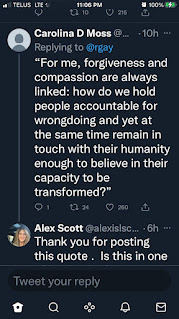
I screenshot this comment many months ago because I was so struck by how this question was framed:

 "How we do hold people accountable for wrongdoing and yet at the same time remain in touch with their humanity enough to believe in their capacity to be transformed?"

It's the question that's a part of the heart of this site. (I saw a part because I think the larger part of the heart of this site is to provide a safe space for betrayed wives to heal and chart out their next steps.) 
There are other sites, of course, that traffic in vitriol, in revenge. There are sites that peddle forgiveness. I like to think that this site does neither — I have tried to create a space in which we acknowledge the deep deep wound of betrayal while at the same time recognizing that a cheater isn't necessarily a monster. But neither is a cheater automatically deserving of our forgiveness. I've tried to find a path somewhere between the two where we can keep our focus on our own pain, our own healing, while — if we choose to — remaining in touch with the humanity of the person who's caused the deep wound. 
Because I remain convinced that, as upside-down as it seems (and I acknowledge that there are exceptions), most cheaters are trying to fix something broken inside of themselves. And whether or not you're interested in rebuilding a marriage with the same person, it can accelerate your own healing if you're able to remain in touch with the humanity of the person who caused your pain.
The reason is simple: In order for us to be able to extend true compassion to someone else, we need to know it ourselves. I had long been a harsh judge of others. I had no time for liars, for scoundrels, for cheats. But when I discovered I was married to someone who was all three, and that I lacked both the energy and the bandwidth to leave right away, I had to try something else.
I wrote about it in 2015: 
"Transformation, I've discovered, isn't a bolt of lightning from the sky. It wasn't magic.
For me, transformation was showing up each day, slowly opening my heart to the possibility that I could handle this. That I was worth fighting for. Not someone else fighting for me but ME fighting for me. That I was enough, just as I was. That I had always been.
And within that transformation, there were many many gifts. Much suffering too. But that, it seems, is where transformation takes root."
By truly coming to believe that I had value, I accepted that my husband had value too. And — it shocks me still to know this — I came to believe that she had value too. That she cheated with a man she knew was married because she had no self-worth. Where had she learned to live on crumbs? 
None of this is to argue that you need to stay married. That you need to forgive him. That you need to forgive her.
It is, however, to say that if we can learn to thread that needle — to hold him accountable for wrongdoing and yet remain in touch with his humanity — we learn healthy boundaries. We learn our own worth and that of others. 
When we believe in others' capacity to be transformed, even in light of wrongdoing, we create the conditions for our own transformation. 

Sunday, April 2, 2023

After Betrayal: Putting Ourselves Back Together

It sometimes feels like we are all forever putting ourselves back together, but I have only ever felt stronger for doing it. It seems to me our griefs are the very things that keep us within the world as active participants in its story, making us more effective and ultimately more joyful, despite, or perhaps because of, our breaking down.

~Nick Cave, The Red Hand Files


It has been a very long since I was where so many of you are. Reeling from the discovery of a partner's affair, or lying awake wondering if he's still cheating, or gaming out what life will look like if you stay or if you go

And yet, the pain can still surprise me — a sudden pang when my husband doesn't answer his cell phone, or an ache that settles in my chest watching a TV show in which a wife is betrayed, or a quickening heart when one of the young people in my life confide that they don't understand why their partner broke up with them. And I think but don't say, "I do. I know. I heard the way she talked about her new lab mate." 

"It sometimes feels like we are all forever putting ourselves back together," writes the always wise Nick Cave. And I know we all imagine a time when we are whole again, when the pain is entirely behind us.

Cave is writing to a reader about grief following the death of someone loved but grief is grief. And there is absolutely no question in my mind that betrayal leaves us grieving. Betrayal is loss. Whether or not the person remains in your life. We lose the person we thought we were married to. We lose the blissful ignorance of our wedding vows (or, if you're unmarried, of the belief that you both were similarly committed to monogamy). We lose the smugness that, somehow, our marriage would beat the odds — that it would remain unmarked by infidelity. 

If we're not careful, we lose ourselves. At least, until we find ourselves again.

But though it might seem to be bad news that "we are forever putting ourselves back together again", I am here — 15 years after my own D-Day — to tell you that pain is pain is pain. And if you can accept that, if you can acknowledge that we all go through pain in this life, it might both make you feel less lonely and more empathetic, to both your own and others' suffering. And pay attention too to the rest of what Cave says: "I have only ever felt stronger for doing it." None of us would ever choose this. And I'm not someone who embraces suffering because I think it's 'good for me'. (Insert eyeroll.) But this pain is yours right now and though I'm not sure it's making you stronger, I do believe it is revealing to you the strength that was always yours. 

And I believe this too: When the pain is mostly behind you, when you are only occasionally surprised by it, you will know also joy that tastes all the sweeter. If you have healed well — with self-respect and time and a soft heart — you will savour any morsels of joy all the more for having felt such deep pain. 

It has been a long time since I've posted here. But know this, too, my secret sisters: I think of you often. It remains an incredible privilege to have been trusted with so many of your hearts. And if this site does just one thing, I hope it is this: To remind you every single day that you are not alone and that you will get through this. 

Sunday, November 13, 2022

All the lessons I continue to learn

Our good friend to Betrayed Wives Club (and who created this kickass design and logo) StillStanding gave me some advice recently. I had told her how conflicted I am about this site. I lack the time to give it the attention it (and you! All of you!!) deserve. But I lack the heart to shut it down. And I lack the creative energy at this point to reimagine it — to figure out a new incarnation that continues to give the support and community that it has provided for so long to so many (more than 4 million over about a decade!).

She told me, in that wide, thoughtful way she has, that it's okay to sort of park it, to perhaps disable comments while still keeping all the posts up, and all the old comments. That it can act as something of an archive for those new to the pain of infidelity — like reading an old book of wisdom that continues to hold value. (Though please know, those of you who don't yet know, that I write something of a guide book, an Encyclopedia, to help you navigate to a place of healing.) 
And I got thinking about how valuable "permission" is — how one of the most important aspects of this site is exactly that: We gave each other permission to just feel that deep deep pain. To sit in the not knowing what to do next. To rage and cry and grow silent and scared. Because we knew, even if we didn't yet know, that all of that was important to healing. Our own and each other's. 
So that's what I will continue to do for now. I'm not yet ready to decide and that's okay. I'm not ready to move away from all of you, and that's okay too. There are far too many times that I'll be thinking about something that has NOTHING to do with infidelity — navigating adult relationships with my children, dealing with my new job, absorbing climate grief from the work I do — and I will hit upon an insight and my first thought continues to be, I need to share this with the secret sisters. Because while so much of relationships with others isn't about infidelity at all, the lessons I've learned healing from betrayal, the support and community we created here, has everything to do with how I negotiate and experience my relationships. Boundaries. Gratitude. Courage. Radical honesty. Waiting. Self-compassion
I hope you'll continue to share your pain and your wisdom and your kindness to each other. I will try to be better at moderating and posting comments.
I miss those of you who have been so pivotal to my healing. And though I may never even know many of your real names, you are so very real to me. 

Wednesday, June 8, 2022

When the war is happening inside

Most people haven’t even noticed their strength. They’re so focussed on their pain.

~ Rachel Naomi Remen, author Kitchen Table Wisdom

Our household has recently welcomed a family of Ukrainians, fleeing the war. It's a mother and two daughters – the husband and 18-year-old son remain in their country to defend it. 

I just returned from walking the youngest to the school bus, where she climbed on with a dozen other kids for the ride to her new elementary school. It's been just nine days since she got off a plane from Poland. 

This family is weaving itself into our day-to-day lives. Their dog plays with our dogs and cats. We all sit down to dinner together. We grocery shop together. We jokingly call ourselves "one big happy family." But I notice how often they check their phones and then exchange glances with each other. The other day, they shared with us a photo of a magnificent church in a village near to their own, the turret engulfed in flames

"I don't know how to talk to you about this," my husband said to them, his voice deep with sadness. "But I am so sorry for what you're going through." 

They smiled. Those words, for the moment, were enough. Someone saw their pain. Someone recognized their loss. Someone acknowledged that none of this fair.

I'm awed by their courage. To pack up everything into two large suitcases and a couple of backpacks. To leave their family business, their home, their friends, their husband and father and brother. But they've heard the stories of what's happening to those who stay. They know the stories. And so they roll the dice on a family they'd never heard of before, who lives across the world in a country they'd never been to. They took the chance that they would be welcomed. That they would be safe. That what they didn't know in another country was better than what they knew in their own.

Any time our lives are turned upside down thanks to the actions of a madman, we are thrown into a fight for our survival. Infidelity might not be war but it can sure feel like it. Our bodies don't discern between threats, they only know that the bright alarm is flashing red. And so they fight. Or flee. Or freeze.

But though it might not feel like it, we have choices beyond fight, flee, or freeze. And though you might not recognize it as you're living through it, you have a deep well of strength that you're drawing on even as you're curled up weeping on the floor. It's a strength that will serve you. It's the strength that gets you to work more days than not. It's the strength that parents your children, that comforts them. It's greater than your pain. 

Rachel Naomi Remen, the provider of the quote at the top of this post, was diagnosed with Crohn's Disease in her early teens. She spent a decade, she says, "angry". And of course, she was. It wasn't fair that she had a disease that, she was told, would cut her life short, would cause pain and discomfort. It's not fair that Ukrainians are fleeing their homes because of an ego-driven authoritarian. It's not fair that our own lives have been turned upside down because of a partner's betrayal. We can choose anger, which is reasonable. And maybe we have to spend some time there. But we can also recognize that, greater than the pain, is a strength that will help us straighten our spines and walk into a future that might not be the one we'd have designed but that we can make beautiful too. 

Tuesday, August 24, 2021

What is possible for you today?

 ...the trick in life is not to try harder but to resist less.

~From a conversation with Anne Lamott, Washington Post


I am the queen of trying harder. I have a daughter who's the princess. When she was young, I posted a quote on my fridge that read something like: Reasonable people adapt to suit the world. Unreasonable people try to change the world to suit them. Therefore all progress depends on unreasonable people.

It was my way to put a positive spin on my daughter's "spirited" personality. It was my way to put a positive spin on my own personality. Somewhere, perhaps before birth, I became wired to believe that I could make anything happen simply by trying hard enough. That I could change my world through sheer force of will.

It's a tough lesson to unlearn. And living with addicts, both as a child and an adult, didn't do much to change my mind despite overwhelming evidence that I was changing nothing except myself, and not in a good way.

The lesson eventually stuck, however, and I am now convinced that our happiness, or at least our peace of mind, depends on learning the new lesson. Depends on accepting that no matter of trying can change another person uninterested in changing. No matter of trying can unbreak a heart. What's more, I've come to understand that so much of my own healing, my own growth, has come not from trying but from releasing: Expectations. Perfection. My breath.

There's magic in release. Almost instantly, our bodies relax. Our hearts soften. Toward others definitely but also towards ourselves. Which is what prompted me to write this to one of our secret sisters who is working so hard to forgive her husband and herself:

I sometimes think that our valiant attempts to forgive ourselves and him can exhaust us. I have come to believe that rest is at least as important. To give ourselves a chance to just breathe. To take it moment by moment. To stop looking ahead in the hopes that we see a rosier future than our current present. I think aiming for acceptance is wise. "Today, I am fine. Today, I choose to be here." To focus on cherishing and nurturing our best selves but in a gentle way, not a striving one. We are such a culture of strivers. And yet, I think healing from the trauma of betrayal is learning how to just comfort ourselves in healthy ways as our bodies and mind adjust.

The brilliant Kate Bowler puts it this way: Somewhere between "anything is possible" and "nothing is possible" is the question: What is possible for me today?

Putting it that way changes everything, doesn't it? What is possible for me today? It takes the pressure off. It gives us a break. It allows us to nap. To be angry. To sob into our pillows. It accepts the truth that today is just...today. It is not forever. It is not necessarily predictive of anything other than what we can manage right now. What a way to live our lives – moment my moment. Hour by hour. Day by day.

I'm often asked how I got through those horrible early months post D-Day. And it was like crawling over broken glass. But broken down into those moments, it was manageable. Not pleasant. Often painful as hell. But manageable.

We get through not by trying harder. We've done that, haven't we? It didn't work out so great. But by resisting less. By being easier on ourselves because healing from betrayal is, perhaps, the hardest thing we've ever done so we deserve some kindness, some gentleness, some nurturing, some, yes, forgiving. We get through by unclenching our jaw. By letting the house be messy. By letting our kids watch TV for the 24th day in a row. By screaming all our lost dreams into the pillow. 

What is possible for me today? What's possible is to try, just the tinest bit, to release yourself from having to feel better. From having to forgive either him or yourself. Release. Try it. 


Friday, December 18, 2020

Justice for the pain? Or witness to the wound...

One of the most difficult things about healing from being hurt by others is how to put wounds to rest when those who have hurt us will not give air to the wound, will not admit to their part in causing the pain. I have struggled with this deeply. Time and again, I find myself confusing the want for justice with the need for a witness of the wound.

~Mark Nepo, The Book of Awakening


One of the more common laments I hear on this site is how the OW isn't "paying" for what she did. If she was single, well, she just moves on. If she's married, we imagine that her husband either doesn't know (and most don't want to tell him) or that he's chosen to move past it. So really, what we're saying when we want the OW to pay for our pain is that we want to see her pay. We want it to be public. Oprah once said that the downside of the karma bus was that we rarely got to see it run over those who did us wrong.

And I get it. Justice. We just want justice, right? Except that focusing on justice – the price we think she should pay (and our husband should pay, for that matter) – often keeps us focused outwardly. Away from the pain. Away from the wound.

But what I've learned through healing from betrayal is that focussing outward keeps us a step removed from our wound but connected to the person who helped create it. It's like being in the middle of the road with a broken leg and trying to chase down the person who ran us over. What we need to do is fix the break first. 

But a broken bone is one thing. It shows up on x-rays. A broken heart is another thing entirely. We don't know how to effectively treat a broken heart. And so we tell ourselves that we're being pathetic. We chastise ourselves for our tears. Why aren't we over this? What's wrong with us? We need a witness for our wound, as Mark Nepo says, and yet we can't even do that for ourselves. Far easier, it seems, to stalk her Facebook or Instagram for signs of her misery. Far easier to drive by her house and see the curtains pulled tight. 

None of this is easy, my friends. Healing from infidelity just might be the hardest thing you'll ever do. But it starts with acknowledging your pain. Acknowledging just how deep the wound goes. And summoning other witnesses to it, who can assure us that they know it's there too.

It might not erase our desire for justice, our need to see those who hurt us somehow pay for the damage they caused. But it also might. By the time I began to feel healed from my own broken heart, I no longer cared about the OW. I knew by then she had remarried and had a baby. And I hoped, for the baby's sake, that she had done some healing of her own. I hoped for the sake of other women that she never wanted to cause such damage in another's marriage again. But that was nothing I could control. And so I let go.

Monday, June 1, 2020

Using Our Pain To Make Space for Others' Pain

I’ve had a hard time showing up here the past week or so. Like so many, I’ve been gripped by images of protests around the United States and even Canada, where I live. It’s not that I’m not feeling your pain right now. I am. I’m feeling it more acutely because of the clear pain that so many others are feeling right now. My heart feels broken open yet again for a world in pain.
I won’t pretend that I know what it’s like to be Black in the world right now. I have the privilege of growing up in a culture that prioritizes whiteness, that confers upon us status and goodness that we have not necessarily earned. A culture that, largely, protects me. But even with my privilege, I know what it feels like to be betrayed. You know too. And if we’re open to it, that pain we know, that agonizing pain of betrayal, can help us remain open to the pain of others who have felt betrayed for generations. It can help us keep quiet while we listen to their stories. It can, as Nadia Bolz-Weber urges us to do, help us stay curious
What did you want more than anything in the wake of betrayal? (Except to undo what had happened, of course.) I know what I wanted: Someone to really hear my pain, to not look away, to not wish I were over it, to not imply that my pain was inconvenient or uncomfortable or undignified. I read a quote online this past weekend that resonated: Don’t let those who denied your pain tell you how loud to cry.
The images we’re seeing might look to some of us like an over-reaction. But – oh man! – can I relate to the urge to burn it all down. To act out my rage. When the world won’t listen to our whispers, what choice do we have but to scream.
I am going to count on you, my incredible invisible sisters (and brothers), to keep your comments respectful. I know that what’s happening right now has our emotions heightened. Those among us who are people of color, who belong to marginalized groups, need our compassion right now, not our judgement. They need those of us who’ve been broken-hearted to use that pain, that memory of trauma, to hold ourselves open to their pain. To make space for it. And to understand that their stories hold as much truth as ours.

For those struggling, here are few suggestions for self-care:
•limit your use of social media
•donate to causes that can use your money to amplify their voices
•escape into a book, a movie, a TV show, a hike in the woods
•you are not selfish if you simply do not have room for any more pain right now. You must tend to your own wound first

Tuesday, October 15, 2019

Avoiding the Shadows, Our Own and Others


I was in my therapist's office, citing a laundry list of the ways in which my eldest daughter was making me crazy. Exasperated, I concluded with, "this isn't who she is. I'm not sure what happened to her but this isn't her."
To which my therapist, mother of two formerly teenage girls, responded, with a wry smile, "But it is."
Gulp. 
Of course it is. My daughter is not just made up of parts I like or approve of. She is a whole person who will not always behave or believe or respond in ways that suit me. 
I should have known this, of course. My husband, the one whose fidelity to me I would have staked my life on, had already blown open the myth that people are entirely made up of parts we see. Parts we like. Parts we approve.
And it's not just others. I have parts of myself I keep hidden. Since I was a pre-teen, just learning that "pretty" was currency, I've assessed every situation in terms of where I fit in on the "pretty" scale. I loathe that in myself. What self-respecting feminist does this? Uh...this one. 
But it's only by being conscious of that in myself that has allowed me to challenge it. It is only pulling these shameful parts of myself from the shadows that has provided me the opportunity to acknowledge how shallow it is. What a ridiculous metric it is. And that, ultimately, it reflects neither my worth nor anyone else's.
Being conscious. How many of us are? How many more of us are oblivious to the ways in which we point at others and sneer for exactly the characteristics or behaviour we loathe in ourselves? 
I have a friend, a 12-stepper, who does this exercise whenever she finds herself obsessing about someone for a transgression or a personality trait she hates. She writes the person's name at the top of page of a sheet of paper. Then she lists everything about that person that she hates. Every. Single. Thing. It's soooooo satisfying, right? All the ways in which this person deserves scorn. 
And then...
And then she crosses out that person's name and replaces it with her own. And lo and behold, so many – sometimes all! – of those same traits are exactly what she doesn't want to see in herself.
Gulp again.
"Cad" is a Twitter friend of mine, a repentant cheater whose dedication to excavating his sins is admirable, though I worry his self-loathing is becoming a lifestyle. 
A recent post on his site speaks to what "Poet", another Twitter friend whose tweet is posted above refers to. This desire to avoid others' shadows, which, of course, is really about avoiding our own. We wouldn't be so frightened of others' darkness if it didn't remind us of our own.
Which reminds me of another thing I've noticed recently, when I consider my approach to healing from infidelity alongside the "once a cheater, always a cheater" camp's. What I've noticed is that those of us who can't find compassion for others might want to start with ourselves. Only when we can truly let ourselves off the hook for being duped, for being trusting, for being loyal, for being played, for being...human, can we learn to truly extend that same compassion to others, no matter what they've done. You are not required to feel compassion for someone who's betrayed you. And it's certainly normal to feel rage and disgust and vengeance and deep hurt. 
But, though it might seem counter-intuitive, being able to extend compassion for others' dark sides, for those parts of themselves they kept hidden out of shame or fear or lack of awareness, releases the shackles we wear. It frees us to love the flawed person seeking to be better, or to wish them well while choosing to not have them in our lives. Either way, we're liberated.
It took me  a lot of years to acknowledge and accept those parts of myself I'd relegated to the shadows. Even now, there are things that pop up – a bias I have, or an ill-considered opinion – that makes me cringe. And surely there will be more. But what freedom it is to notice those things about myself, to challenge myself on them, and to still know that I'm worthy of being loved, of being in this world. So is my daughter, whether or not I agree with or approve of things she does. And so is everyone else.


Friday, September 27, 2019

Guest Post: Trust: Is your marble jar full or empty?


One of the many challenges we face as a betrayed wife (or partner) is around trust. How can we trust him again? Who can we trust with ourstories? Will I ever trust anyone again? Will I be able to trust my own judgment?

I was recently in a two-day Brené Brown - Dare to Lead, intensive workshop facilitated by a certified Daring Way coach. We spent a lot of time on trust. How to build it, how to lose it, how to recognize it when it is there. We listened to the story of Brené’s daughter losing trust in her best friends and her deciding to never trust anyone again, ever. Brené uses the analogy of a marble jar to help her daughter understand how trust is built. As people share stories about themselves, engage in small, everyday acts of empathy, or show up for real when you need them, marbles are added to their jar. The more stories they share, and show up, the more marbles you are able to add to their jar. It is easy to trust someone whose jar is overflowing. Your marble jar people aren’t necessarily people who are in your life all day, every day, but over time, with small acts, they’ve filled up their marble jar. And if you think about it, you know who those people are. There may not be a lot of them, but I think that’s appropriate. Trust is earned.

When you are going through hell, you only need one marble jar person. That one person will hear your story without judgement and will ask, what do you need? how can I help? And if you listen to your body, you already know who your marble jar person is. You’ll feel a yes. You’ll feel relief when you think about sharing with them and being in their presence. You will likewise have friends, who are your day-to-day besties or even close family but whom you also know, for whatever reason, do not have a full marble jar. You’ll get a no from your body on them too. You’ll feel resistance or anxiety when you think through sharing your story. And that resistance may be because of the ways they haven’t showed up for you in the past. Think carefully about your people and see if you can identify one marble jar person. Sharing with them can make a huge difference in your journey back to trust.

Now think about our partners. They’ve managed to empty the marble jar in one go. And we wonder, as betrayed wives, why we can’t trust them again completely right now, as if trusting them was somehow on us. It’s not. Of course, you don’t trust your partner in the way you did before. The jar is empty and it is not your job to fill it for them. They must make the effort to put the marbles back in the jar. And this is where shit gets real and difficult. Because refilling that marble jar is a function of time and consistency. Is he doing the hard work of figuring out his own stuff, consistently, over time? Plonk, in goes a marble. Is he showing up for and holding space for your pain, consistently, over time? Plonk, in goes a marble. Is he making an effort to let you know where and when he’ll be and checking in, consistently, over time? Plonk, in goes a marble. Is he being trustworthy, consistently, over time? Plonk, marble. (The marbles are going to plonk for a long time because that jar is big and really empty.) You don’t suddenly arrive at trust, just like you don’t suddenly arrive at forgiveness or “over it.” It all takes time, that four-letter word.  Elle tells us that her trust for her husband came back over time because he consistently showed up and did the hard work that refilled the marble jar. You can take as much time as you need, and you’ll know, eventually, whether he’s making the effort to fill the jar or not.

Now think about you. Learning to trust yourself is a bit harder.  This may require the help of a coach or therapist because sometimes we need an outside perspective to remind us to be gentle with yourself and to help us dig in to the old stuff that keeps us stuck. Learning to trust what we know begins by being gentle with ourselves, by tuning in to the way we talk to ourselves about ourselves. Are we going to trust someone whose words are harsh and full of judgement? Probably not, even or especially if that person is us.  We can build trust in ourselves by tuning into our bodies and learning to trust what t tells us.  Are you hungry? Eat. Are you tired? Sit down, lay down, take a break.  Restless, mind whirring? Journal, go for a walk. But start giving yourself what you need, and you’ll start filling your own marble jar too.  This also takes time, practice and consistently showing up for yourself.

For more resources and reading, please consider visiting https://brenebrown.com/ . Her work is both accessible and life changing. It’s a great first step in reconnecting with yourself and learning about how love and trust are inextricably linked.

Monday, March 6, 2017

The loneliness of the betrayed wife

Betrayal is lonely business. Not only are we left reeling from the shock of a husband's affair, we're experiencing it in a culture that leaves women with few publicly acceptable options about how to respond. No matter whether we leave or stay, there's a stink attached to betrayal, a pervasive blame that, surely, we must have done something to get cheated on. Even if that something was not having the sense to marry someone who wouldn't cheat.
It does an effective job of silencing us, of isolating us from exactly the support we need most. In that moment when we need an army around us, assuring us that we did nothing to deserve this, reminding us of our strength, and supporting us as we heal, instead we retreat.
We have good reasons, of course.
My husband's career depended, to some extent, on being trustworthy. While I recognized the hypocrisy of an industry rife with alpha males with mistresses putting on this public face of honesty and integrity, I nonetheless knew that an unemployed husband (or ex-husband if that was the route I took) would damage our whole family. So even as those around him worked to quietly remove his assistant with whom he was cheating from the office – an expensive maneuver – I kept silent.
I kept silent because his family would, likely, have either disowned him or humiliated him, neither option a good one. I recognized pretty quickly that their long-held judgement about others was a big part of why we were in this mess.
I kept silent because, for years, I had listened to the whispers about others. The knowing glances about a guy who was cheating on his wife. The snide remarks about why.
I kept silent because I live in the same culture as you all do – where I can't purchase bread at the grocery store without walking a gauntlet of magazine covers boldly proclaiming "BETRAYED" over some miserable celebrity's face. Infidelity as entertainment. Betrayal as gossip.
We pay a price for that silence. Aching loneliness. Paralyzing isolation. A lack of perspective. A toxic stew of self-recrimination, shame, fear, loathing.
We need to tell our stories.
We need community.
We need our soul warriors, our sisters. We are fighting at a level that others can't see, not for our marriages or our families but for ourselves.
We need witnesses to our pain.
We need midwives for our rebirth.
Loneliness stops here.
It stops the minute you Google "my bastard husband cheated on me and I'm dying here..." and up popps Betrayed Wives Club, "your kickass survival site".
It stops the minute you begin reading words that sound as though they formed in your own heart. Words about profound sadness, about anger, about fear and confusion and a hurt so deep we believe it will never go away.
It stops the minute you realize that you are not alone. Not at all.
There is an army of soul warriors – souldiers, if you will – fighting the same invisible fight that you are.
Betrayal is lonely business. But it doesn't have to be.
Somewhere we can find the courage to post our story. Somehow we can begin discerning which among our real-life friends can deliver the required compassion we need to help us heal. We can read how others have re-discovered a strength and a wisdom they never knew they had. We read their evolution, whether they stay or go, into women not afraid to value themselves, to be heard, to take up space.
We can pick up the phone and make an appointment with a counsellor. And make an appointment with a different counsellor if the first one says something stupid like "you need to learn to forgive him and stop dwelling in the past".
Betrayal is lonely when isolate ourselves.
Reach out for support.
Ask for help.
We are soul warriors and you are among us.
Not alone at all.


Wednesday, October 5, 2016

Wednesday Word Hug

Hope
by Victoria Safford
Our mission is to plant ourselves at the gates of Hope—
Not the prudent gates of Optimism,
Which are somewhat narrower.
Not the stalwart, boring gates of Common Sense;
Nor the strident gates of Self-Righteousness,
Which creak on shrill and angry hinges
Nor the cheerful, flimsy garden gate of
“Everything is gonna’ be all right.”
But a different, sometimes lonely place,
The place of truth-telling,
About your own soul first of all and its condition.
The place of resistance and defiance,
The piece of ground from which you see the world
Both as it is and as it could be
As it will be;
The place from which you glimpse not only struggle,
But the joy of the struggle.
And we stand there, all of us, beckoning and calling,
Telling people what we are seeing
Asking people what they see.

Tuesday, July 5, 2016

How Far Will You Go?

I was listening to a radio program the other day featuring a guy who lost the use of his legs in a horrible cycling accident. After spending a year grieving the loss of the life he thought was his, he had a moment with his father in which the two just held each other and cried. And then his father whispered something in his ear: How far will you go?
How far will you go? What a question, huh? Not, what are you going to do about this? Not, how will you handle things? But...how far will you go? Less a question than a challenge. A challenge to face the future with grit and hope but also a declaration of confidence and support. With those words, that dad wasn't just encouraging his son to look forward rather than back. He was telling his son that there were still big dreams out there for the taking...and that he believed in his son's ability to seize them. He realized that nothing was going to bring back the use of his legs – at least not in the same way – but that just because his future looked different than he thought, that didn't mean worse. It just meant...different.
And so he set about re-igniting the passions he'd always had for physical exertion and achieving goals. He swam the English channel, competed in the Olympics, got married and, in the process, developed humility and gratitude.
We're all on a hero's journey. Every single one of us. We strive. We fall down. We lose our way. But at each juncture, we have a choice. To accept where we are with no hope for change, or to realistically assess our circumstances and fight for our lives. Maybe not the lives we thought were ours...but the lives we can still have if we ask ourselves just how far we will go.

Monday, June 6, 2016

Healing from Betrayal: How to Counter Counter-Moves

My daughter is frustrated. She has a friend who routinely suggests grabbing something to eat after school but who inevitably turns out to be broke and unable to pay for her part of the snack. 
A third friend, whose parents keep her well supplied with money, will usually step in and pay for friend #2. This drives my daughter, who works hard for her money, crazy. 
"She taking advantage of [Friend #3]," my daughter wails. "And it makes me look cheap when I won't also chip in to cover [Friend #2's] meal."
I try to remind my daughter that she can only control her own actions, not those of her friends. And to pay for a friend and then resent having to pay isn't respecting her own boundaries now is it really respecting the friendship. 
Thing is, my daughter has choices in this situation. She just doesn't like them. 
And who can blame her? Drawing that clear line around our boundaries is really uncomfortable. We want people to like us. We want people to think good things about us. 
Besides, counter-moves are almost inevitable whenever we make our boundaries clear.
Counter-moves are the responses we get from people who far prefer our boundaries to be fuzzy and easily manipulated.
We see them most transparently with kids. Think of the last time you told a child he/she couldn't do something – watch TV, have a cookie before dinner, stay up late. Did the child respond with, "I understand. And I appreciate you even considering my request."
Uh...don't think so.
More likely you heard something like "You're the meanest person in the world. Jeremy's mother lets him [fill-in-the-blank-here] any time he wants. I hate you." Or maybe you heard: "You're not the boss of me. I can do whatever I want." Or perhaps it was something like: "Fine. I don't care. I didn't want that anyway." There's usually some eye-rolling, or arm crossing, or stomping involved.
Depending on our own personalities and understanding of boundaries and counter-moves, we're likely to get hooked into one type of counter-move more than others. For me, it's anger. The minute someone in my family gets angry at me, I'm hooked and I'll match them holler for holler. 
With my kids, it became easier to see when they were delivering counter-moves. Sometimes they were quite hilarious, like the time my then-five-year-old daughter packed her bags to leave home because we had said "no" to something and she had no choice but to leave a home in which she wasn't treated well (ie. given whatever she wanted). We said we would miss her very much and that if she ever changed her mind and felt that she could live with our rules, then she was always welcome back. After testing our resolve, she harrumphed and went upstairs to unpack. 
The adults in our lives aren't always so transparent. 
Do any of these sound familiar?
"You're just like your mother."
"You only think of yourself."
"You're so controlling."
"You're acting crazy."
"Stop being jealous."
"Nothing makes you happy." 
Every single one of those statements is about getting you to back down. And they often work. The last thing we want is to sound like our mother. Or feel selfish. Or controlling. Or crazy. And so we insist that we're not doing that at all...are we? And in that instant, our boundaries get fuzzy. We soften things a bit. "It's just that, I can't sleep until I know you're home..." or "I just need to know that you're not in touch with her...." Those "just"s or "I only..."s weaken your boundaries. 
Barbara Coloroso, who's a parenting expert but whose advice works with anyone in our lives, calls these typical counter-moves "cons": 
Con 1 is weeping, wailing, begging, bribing, gnashing of teeth ("Please don't check my texts. I promise there's nothing there. You have to trust me. I would never ever hurt you again...") 
Con 2 is anger and aggression. ("How dare you check my phone! You violated my privacy. If you won't trust me then there's no point in staying married.")
Con 3 is sulking/pouting. ("Fine. Do whatever you want. I don't care....")
Cons are powerful. They hook us and, if we're not good boundary-enforcers, next thing we know, we've backed down. 
But when we back down, we poison the relationship with our own negative feelings. Resentment. Frustration. Anger. Hurt. Fear. 
We might have kept the peace for the moment but we've paid for it by contributing to the dysfunction.

What does this look like after betrayal? Well, let's continue with the example above – to have total transparency around your partner's phone or computer. We want passwords and access to all records and accounts. 

It would be lovely if our partner responds that he understands that this is part of rebuilding trust. Many, however, give us countermoves. You're never going to trust me again, are you? No matter what I do, you find fault with it. I can't win with you. 
Or: I refuse to live like a prisoner in my own home. I told you I wouldn't cheat again. I've learned my lesson. If you can't believe me, that's your problem.
Or: You need to just trust me. Let's put this in the past and move forward. It's unhealthy to keep hashing it out.
What's more, some of it is probably true. You likely are hard to please right now (uh, duh. Wonder why?). You are also doubting you'll ever trust him again. But that doesn't make the counter-moves less toxic. And it doesn't change the fact that you are making a reasonable request under the circumstances. You're making clear boundaries in order to respect yourself within the relationship. 
You can commiserate if you'd like ("I'm sure it does seem humiliating to have to show me your phone messages but I need to see them in order to silence my fears that you're still cheating on me."). You can murmur sympathetically that, "yes, it does seem as though I'm hard to please right now." But that doesn't change the fact that you're respecting yourself and what you need within the relationship.
Recognizing and responding to counter-moves gets easier with practice. 

I asked my daughter what might happen if she began to ask her always-broke friend if she had any money before agreeing with her to go out for food. My daughter admitted she'd feel really uncomfortable asking and that her friend might only hang out with the other friend who paid. Or she might tell people my daughter was a cheapskate. And then, before I could even respond, my daughter said, "I know, I know. Counter-moves."

Exactly. 
At a certain point, when we consistently refuse to back down, the people in our lives realize that the counter-moves aren't going to work.
And they either stop...or find others with whom the unhealthy dance can continue.
Either way, we win. 


Monday, April 18, 2016

"The wisdom, the roadmap, the hope"

A while back, Snowbird shared her story on the Feeling Stuck Part 14 forum (so many incredible women on this site). And she also shared this:

To those dealing with repeat offenders, I told H this: If you can't control your behavior, we might be friends but we won't be married. Therapy, medication and meetings were game-changers for him. 16 months and counting.
Hang in there, warriors. Before this site, I thought it was kick him to the curb or be a doormat. You’ve taught me that I can stay if the conditions are right. Thank you for the wisdom, the roadmap, the hope. 

When I read about healing on this site, there's often one common thread. Those who've managed to rebuild their marriages haven't done it through wishful thinking. They've drawn clear lines, they've made demands, they've insisted upon accountability. They've understood that giving someone a second chance is a gift. And that they get to decide whether their partners deserve that second chance. They've looked with critical eyes at what, exactly, their partner is doing to create the conditions for reconciliation. 

It looks almost easy from the outside, doesn't it? It looks like some people simply know the rules better than the rest of us. That they have access to a post-betrayal roadmap that the rest of us don't have. 

And maybe they do. Maybe that post-betrayal roadmap is something they've had all along. I suspect it is. Not something they can hold onto but something they just know: That they are worthy of respect and dignity and honesty. And it's from that place of knowingness, that place of valuing themselves that they are able to respond to their partner's betrayal. 

They may have moments of doubt. They might wonder fleetingly what's wrong with them that their partner cheated. They may slip into self-blame. But they manage to pull themselves away from that and remember: They are worthy. They are and have always been enough and if their partners can't remember that too then there's the door.

Try and imagine yourself responding from that place. Pretend you're that person. How would you respond differently? Would you be able to calmly make demands? Would you be able to make it clear that you have rules for reconciliation that he can either follow or leave? Would you be able to better feel the pain and the fear without losing yourself in it?

What I'm suggesting is so incredibly difficult for so many of us. But that difficulty comes from who we believe ourselves to be in the world. It comes from valuing the love of someone else over the love of ourselves...and that will always create a power imbalance in a marriage. It comes from fear that, if we don't make it "easy" to love us, then we won't be loved.

Snowbird refers to "repeat" offenders but I think her advice holds for all offenders. If you are asking me for a second chance, then here's the deal... And then lay it out. It's not about punishment. The idea isn't to create all sorts of conditions to punish him. It's to create a safe space in which you can rebuild trust, rebuild a marriage based on honesty. It's about loving yourself at least as much as you love the other person. 

It's about healing yourself through dignity and self-respect. No matter the outcome of your marriage, you will be loved if you're able to love yourself. 


Saturday, March 26, 2016

Feelings are not facts and they are not forever

I think one of the issues that we have is that we don't necessarily recognize that a thought is just a thought. We have a certain thought, we take it to heart, we build a future on it, we think, "This is the only thing I'll ever feel", "I'm an angry person and I always will be", "I'm going to be alone for the rest of my life", and that process happens pretty quickly.
~Sharon Salzberg

My life is in transition. Or more accurately, the lives of those around me – three teenagers – are in transition and therefore mine is too. My eldest is thinking about colleges and careers, my middle one is embracing high school, and my youngest, just turned 13, has discovered the mirror and the face she sees reflected back at her. 
And I am increasingly relegated to the sidelines. Having been the first person my kids turned to for anything, whether for dinner, help with homework, or an aching heart, these days I'm more often on the outside of conversations between my kids and their friends. It's developmentally appropriate, of course. I know this. I understand the power of the peer group and know that my young adults need to venture forth to test out their wings while the nest is still near enough for retreat when necessary.
But that doesn't mean it doesn't hurt.
And so I find myself, more than I'd like to admit, convinced that this sadness will follow me the rest of my life. That the best days are behind me. That I spent the potentially best years of my career focussed on raising children. That I squandered years nursing my broken heart post D-Day. 
I wallow in maudlin thoughts. That's probably the last time I'll ever push my child on a swing, I think. I've probably run my last 10K race, I figure. I doubt I'll ever write a bestselling book, I tell myself.
I feel old. Tossed aside. My best years behind me.
I felt that way after D-Day, of course. I couldn't imagine that I would ever EVER feel okay again. I was sure that the rest of my life, whether I stayed in my marriage or threw him out, would be misery.
I laugh at that now, grateful to have been so wrong.
But here I am, learning the lesson again. I'm sad and sadness can feel like a heavy blanket that we can't imagine getting out from beneath.

But that's today. Today I'm overtired having entertained 20 guests for dinner last night. Today I ate carrot cake for lunch so feel kinda gross. Today I decided not to go for a hike, which always makes me feel better, and instead to focus on the many ways in which my children are breaking my heart. 
I have to remind myself that today is not forever. Today is just...today. A week ago, I felt on top of the world. A week ago, I was in love with my life. A week ago, I felt certain that my career was on an upward trajectory, that many of the seeds I've sown are taking root. I felt adored by my children, cherished by my husband.
My wonderful therapist whose words stay with me long since we've stopped seeing each other used to remind me, gently and consistently, that "feelings are not facts." This was usually in response to some declaration I would make. "I'm miserable," I would say. "I can't live like this for another minute."
"Feelings are not facts," she would say and, at first, I was annoyed. What the hell did that mean? If I don't follow my feelings, then how do I know which course to take?
Her point, of course, was that feelings change. Sometimes over years, sometimes over a day. She wasn't advising against following my feelings, she was advising against making life-altering decisions based on what I was feeling at that exact moment. Sit with them, she would suggest. See if you feel the same way tomorrow. See if you feel the same way after you initiate a difficult conversation. See if these are feelings or facts. 
I try to remember this as I'm called upon to drive my 17-year-old to her boyfriend's place. I'm reminded that just six months ago she felt sure she would never, ever like another boy again, after the one who'd been careless with her heart. And yet, here she is. Smitten. The other boy relegated to the well-that-was-a-mistake pile. 
And even though all she needs from me right now is a drive and I feel small and purposeless, I know that tomorrow will be different. Each day will take my kids further away from me, which is as it should be. But each day can take me deeper into my relationship with my husband. It can open up the time I've long sought to devote to my work. It can provide the space to revive friendships that have languished during the busy years of parenting, interests I've wanted to pursue. 
Today I'm sad.
But tomorrow and the many tomorrows to come can be different. Just like the many yesterdays have been. A blend of sad and happy and confused and hopeful and a zillion other feelings that make up life. 


Wednesday, September 16, 2015

Heartbreak at Any Age

An old weathered heart can still break.
My 17-year-old is nursing a broken heart. After spending much of the summer with a certain young man, she asked him what, exactly, they were doing. In other words, was she his girlfriend? His responses – "I'm too busy for a relationship"; "It's not fair to you because I'm so busy"; "I like you but..." – has made it clear that her desire for more is not his desire. At least not right now.
And so...her heart breaks.
My daughter is kind. She's beautiful. Smart. Funny. She's also achingly open-hearted. Loyal. Guileless. Though there have been a few boys interested in her, none held her attention as anything more than friends. Until this one.
She's had trusted friends suddenly turn on her – some teenage girls can be merciless. Excluded from groups. She was stung by their cruelty. And sad.
But this is different. Perhaps not for her – she seems to be dealing with her heartbreak in healthy ways, seeking out fun with other friends, throwing her energy into school work and extracurriculars.
Nope, this time it's different for me.
Since my daughter confided her heartbreak to me a few days ago, I've felt sick. Food tastes bland. I can't sleep. I have a rock in my stomach that won't budge. I'm having a hard time concentrating on work. My heart aches. There's a weight on my chest. It feels, for all the world, like D-Day all over again.
So I'm putting into practice all the advice I'm forever offering to each of you: I've laced up my sneakers and am trying to walk my way to clarity. I'm trying to eat something – soup, smoothie, anything healthy that goes down easy. I'm meditating to make space for the feelings rather than pushing them away. I'm trusting that these feelings won't sweep me away into an abyss. That they will abate.
Clearly this is triggering in me deep feelings of loss and grief that have nothing to do with this particular boy (who, incidentally, I would like to throttle). I would give anything to spare my daughter this particular pain, one that cuts into our sense of who we are, that challenges our belief in our worth.
I remind her, gently, that she will likely go through this a few more times at least – heartbroken at being rejected or heartbroken at rejecting another. Rejection. It's a cruel word. One that speaks to our sense of feeling alone. Cast aside. Unvalued.
But we can withstand rejection when we don't reject ourselves. I'm reminding my daughter that this boy's inability to place value on her right now is a reflection of him, not her. A diamond unrecognized is still a diamond. 
And I assure her that, no matter what life dishes up, I will, as long as I'm alive, provide her a soft place to fall. But that I hope she'll continue to create such a space for herself. To be gentle with herself. To keep her heart open to all life has to offer, including the really really tough bits.
I'm heartened to see she's instinctively encouraging her own healing. She's spending time with a friend who's going through his own heartbreak – the two are shoring each other up and making each other laugh. She's launched herself into a running campaign with plans to tackle a 5K race in a few weeks. Yesterday, during lunchtime, she sought out the practice room at her school and played piano, texting me that she just thought she "needed to be alone."
In the meantime, my D-Day Revisited continues. So I try, really really try, to follow her lead.

LinkWithin

Related Posts with Thumbnails